| Beginning in 1872 the Navy categorized its ships in four rates, 1st through 4th, which were based on displacement tonnage. Analysis of the 2nd and 3rd Rates showed that both contained two lines of development, one larger and one smaller, and this totally unofficial subdivision is used here. The break for 2nd Rates was at around 2500 tons. |
-- Lackawanna Class
| Note: In August 1861 a board examined plans for "fast screw steamers" and decided on an Ossipee type ship lengthened to carry a third large pivot gun. The ships were to have no broadside guns. Isherwood's engines for all six were identical to those in Ossipee.In circa October 1861 six such ships (including Sacramento, wrecked in 1867). The Lackawanna pair were built at the New York Navy Yard to similar hull plans drawn by B. F. Delano under John Lenthall's direction, with only small differences between the two ships. All six ships originally had vertical bows and no bowsprits. They received bowsprits in 1865-66 and clipper bows in 1871-72. |
|
USS Ticonderoga (1862-1887) European, South and North Atlantic Stations and Special Service, 1868-1881. Shown at Venice with a straight bow after a 1865 refit and before one of 1869-1871 in which she got a clipper bow, a larger broadside armament, and a ship rig. Photo No. NH 45373 Source: U.S. Naval History and Heritage Command |
 |
|
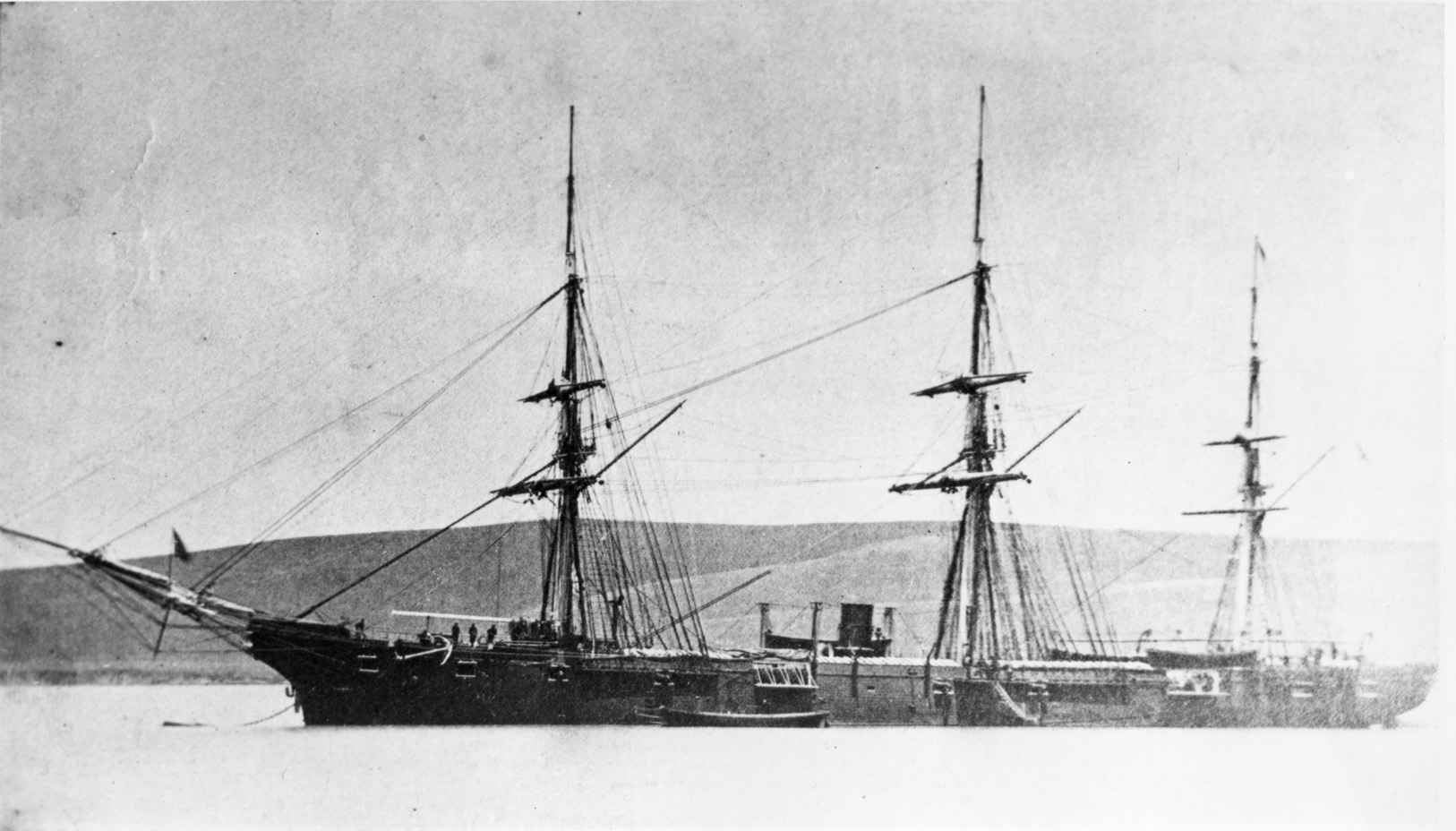
USS Lackawanna (1862-1887) Pacific and Asiatic Stations, 1868-1885. Shown off San Francisco in 1873 after a refit at Mare Island in 1869-1872 when she received a clipper bow, an enhanced broadside armament, and a ship instead of a bark rig. Photo No. NH 51187 Source: U.S. Naval History and Heritage Command |
 |
-- Monongahela Class
| Note: The Monongahela pair were built at the Philadelphia Navy Yard to similar hull plans drawn by H. Hoover under John Lenthall's direction. Monongahela had slightly fuller lines amidships and more rake to the stern than her near sister. |
|
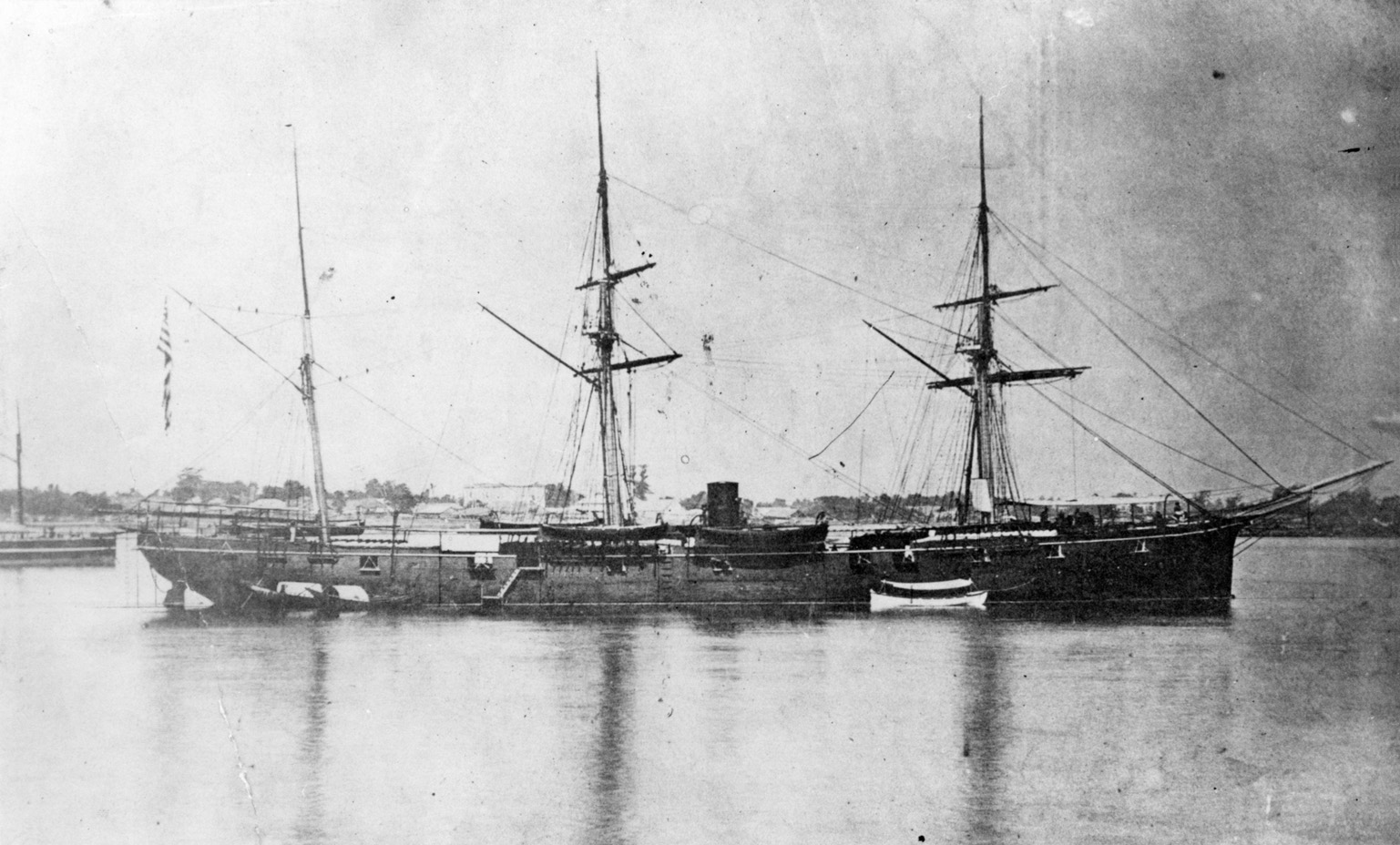
USS Shenandoah (1862-1887) Asiatic, European, South Atlantic, and Pacific Stations, 1868-1886. Probably shown on the Asiatic Station or returning from it with the bowsprit that she got in a 1865 refit but without the clipper bow that she got in 1869-1870. Photo No. NH 59823 Source: U.S. Naval History and Heritage Command |
 |
|
USS Monongahela (1862-1908) South Atlantic and Asiatic Stations, 1873-1879. After being beached by a tidal wave at St. Croix in 1867 she was rebuilt in 1869-1873 with a clipper bow and quarter galleries as shown here. She became a sailing storeship in 1883 and a sail training ship in 1891. Photo No. det-4a13916 Source: U.S. Library of Congress, Detroit Publishing Co. collection |
 |
-- Canandaigua
| Note: Canandaigua, a single ship, was built at Boston with a straight bow and no bowsprit to plans drawn by W. L. Hanscom under Lenthall's direction. She had her forward pivot gun on a long forecastle deck and thus lacked the pivot ports forward in the others. She received a bowsprit with her bark rig at Boston in 1865 and a ship rig and a clipper bow at New York in a 1869-1872 refit. |
|
"USS Canandaigua" European and North Atlantic Stations, 1868-1875. No illustrations. Comparison with ship plans in the National Archives shows that this photo of a sloop at the Boston Navy Yard, identified by an old caption as Canandaigua and often so cited, is actually Juniata before she was refitted at Boston in 1872-1873. The most visible clue is that, of the two ships, only Juniata had a clipper bow and a bark rig at the same time. Photo No. det-4a13887 Source: U.S. Library of Congress, Detroit Publishing Co. collection |
 USS Juniata USS Juniata |
-- Benicia (ex Algoma) Class
| Note: In November 1866 the chief of the Bureau of Construction and Repair noted that the screw gunboats Resaca and Swatara had been found very efficient and recommended that the somewhat larger Algoma class for which engines were being built but no hulls had been ordered be commenced. In 1864 the Algomas had been called "fast vessels of a small class." Four new hulls were ordered in April 1867 to perform "with greater economy all the services that could be rendered by larger vessels," some of which they were to replace. The measurement tonnage of 1740 tons for the 1867 design was larger than the notional 1380 tons for the 1864 ships. |
|
USS Benicia, ex Algoma (1868-1884) Asiatic and North Pacific Stations, 1869-1875. Shown here at anchor with funnels lowered and awnings triced up. Photo No. NH 61895 Source: U.S. Naval History and Heritage Command |
 |
|
USS Alaska (1868-1883) Asiatic, European, and Pacific Stations, 1869-83. Here both funnels are lowered and much of her armament is visible. Photo No. NH 63526 Source: U.S. Naval History and Heritage Command |
 |
|
USS Plymouth, ex Kenosha (1868-1884) European and North Atlantic Stations, 1869-1879. Note the letter "P" on the bows of the ship's boats. The photo was taken on her Mississippi River cruise of 1877, possibly in the Baton Rouge area where a photographer named Andrew D. Lytle was active. False quarter galleries were painted on her stern. Photo No. NH 45215 Source: U.S. Naval History and Heritage Command |
 |
|
USS Omaha (1869-1915) South Pacific Station, 1872-1878 and Asiatic Station, 1885-1891. The building on the right partially resembles the custom house at Yokohama, Japan, where Omaha frequently called during her Asiatic Fleet deployment. Photo No. NH 294 Source: U.S. Naval History and Heritage Command |
 |
-- Atlanta Class
| Note: On 3 March 1883 Congress authorized four ships including "two steel cruisers of not more than 3,000 ... tons displacement each" (Atlanta and Boston). These, including the larger cruiser Chicago and the dispatch boat Dolphin, became the "ABCD" squadron, the first four ships in America's "New Navy" of steel warships. The Navy insisted on a main armament of two heavy 8" guns in these small cruisers which forced the designers to accept low freeboard fore and aft. |
|
USS Atlanta (1884-1912) North Atlantic Station and Squadron of Evolution, 1886-1895. Her two 8" guns are in place but lack shields. Photo No. NH 57444 Source: U.S. Naval History and Heritage Command |
 |
|
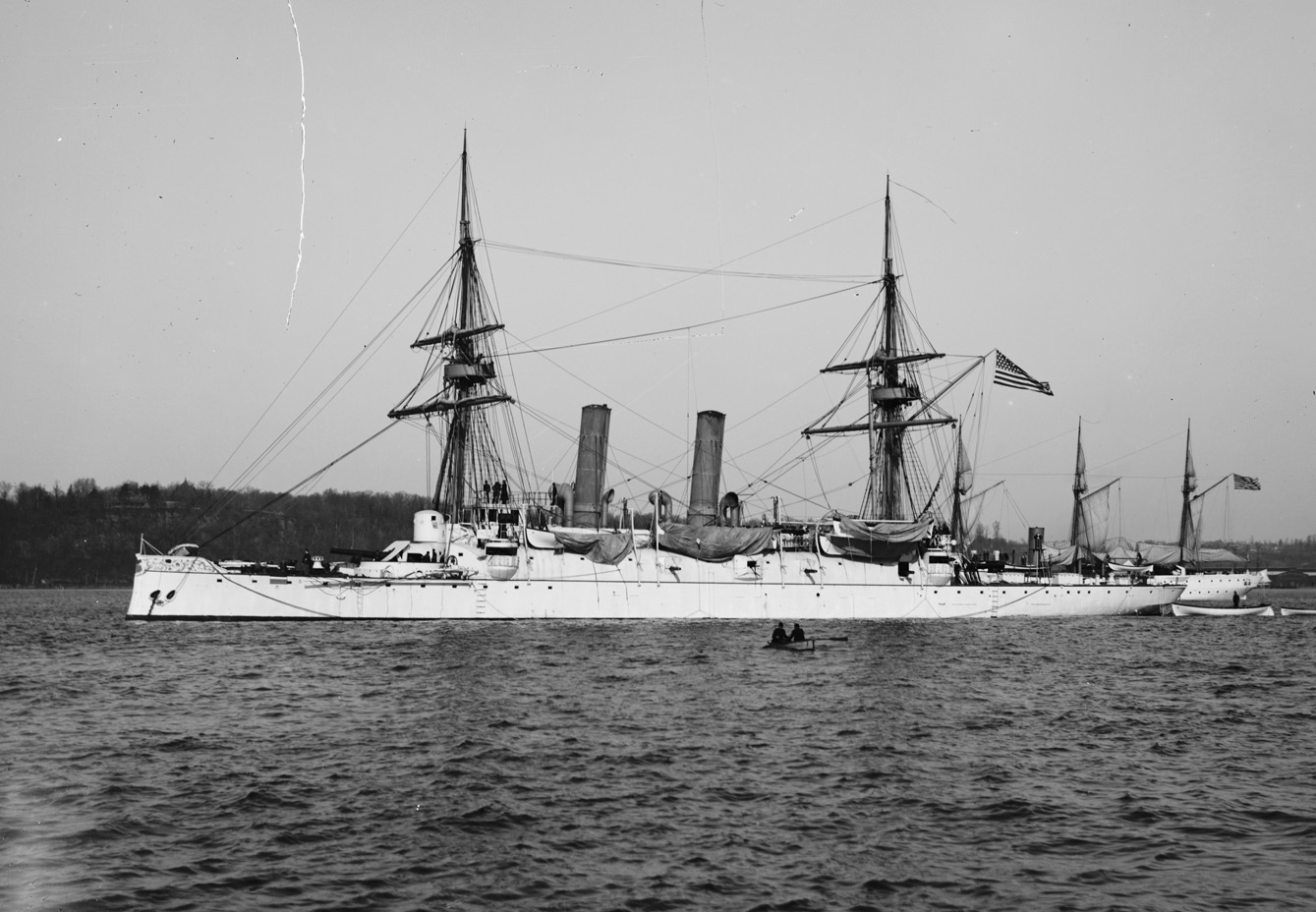
USS Boston (1884-1946) North Atlantic, Pacific, and Asiatic Stations and Squadron of Evolution, 1887-1898. Photo No. det-4a14024 Source: U.S. Library of Congress, Detroit Publishing Co. collection |
 |
-- Cincinnati Class
| Note: On 7 September 1988 Congress authorized seven cruisers including "two steel cruisers of about 3,000 tons displacement each" (Cincinnati and Raleigh). Intended to attack unescorted merchant ships, they had rapid fire guns, high steam power, and a fore-and-aft rig with considerable sail area. They proved to be crowded inside and poorly ventilated, and they received smaller, less powerful engines in 1900-02. |
|
USS Cincinnati (Cruiser No. 7, 1892-1920) North and South Atlantic and European Stations, 1894-1898. Photo No. det-4a14167 Source: U.S. Library of Congress, Detroit Publishing Co. collection |
 |
|
USS Raleigh (Cruiser No. 8, 1892-1920) North Atlantic, European, and Asiatic Stations, 1894-1897. The two ships of this class can be distinguished by their different bow scrolls. Photo No. det-4a14677 Source: U.S. Library of Congress, Detroit Publishing Co. collection |
 |