| Beginning in 1872 the Navy categorized its ships in four rates, 1st through 4th, which were based on displacement tonnage. Analysis of the 2nd and 3rd Rates showed that each contained two lines of development, one larger and one smaller, and this totally unofficial subdivision is used here. The break for 3rd Rates was at around 1400 tons, with none below about 700 tons. |
-- Swatara (2) Class
| Note: These ships were officially earlier sloops of four different types "rebuilt" under a legal fiction that allowed the use of repair funds for new construction, respectively Swatara (1) (steam, 1865), Marion (sail, 1839), Quinnebaug (1) (steam, 1866), Galena (1) (former ironclad, 1861), and Mohican (1) (steam, 1859). Compared to Civil War cruising ships, the ones built in the 1870s had more beam in proportion to length to carry heavier broadside armaments and to stand up well under canvas on long cruises. |
|
USS Swatara (2) (1873-1896) North and South Atlantic and Asiatic Stations and Special Service, 1874-1891. Shown at the New York Navy Yard on 14 May 1874. Photo No. 44611 Source: U.S. Naval History and Heritage Command |
 |
|
USS Marion (1873-1907) North and South Atlantic, European, Pacific, and Asiatic Stations, 1876-1897. Shown off the Mare Island Navy Yard circa December 1897. Photo No. NH 46403 Source: U.S. Naval History and Heritage Command |
 |
|
USS Quinnebaug (2) (1875-1891) European Station, 1878-1889. The name of the tug at lower left is Standish. Photo No. NH 67874 Source: U.S. Naval History and Heritage Command |
 |
|
USS Galena (2) (1879-1892) European, South and North Atlantic Stations, 1880-1890. This photo was originally mis-identified as Alliance, but on the original the letter "G" can be seen on the bow of her steam launch. Recognition features for this class include the quarter galleries and the six gun ports aft of the single pivot port. Photo No. NH 53985 Source: U.S. Naval History and Heritage Command |
 |
|
USS Mohican (2) (1883-1922) Pacific Station, 1885-1895. Shown at Mare Island soon after her completion. Photo No. NH 44606 Source: U.S. Naval History and Heritage Command |
 |
-- Vandalia
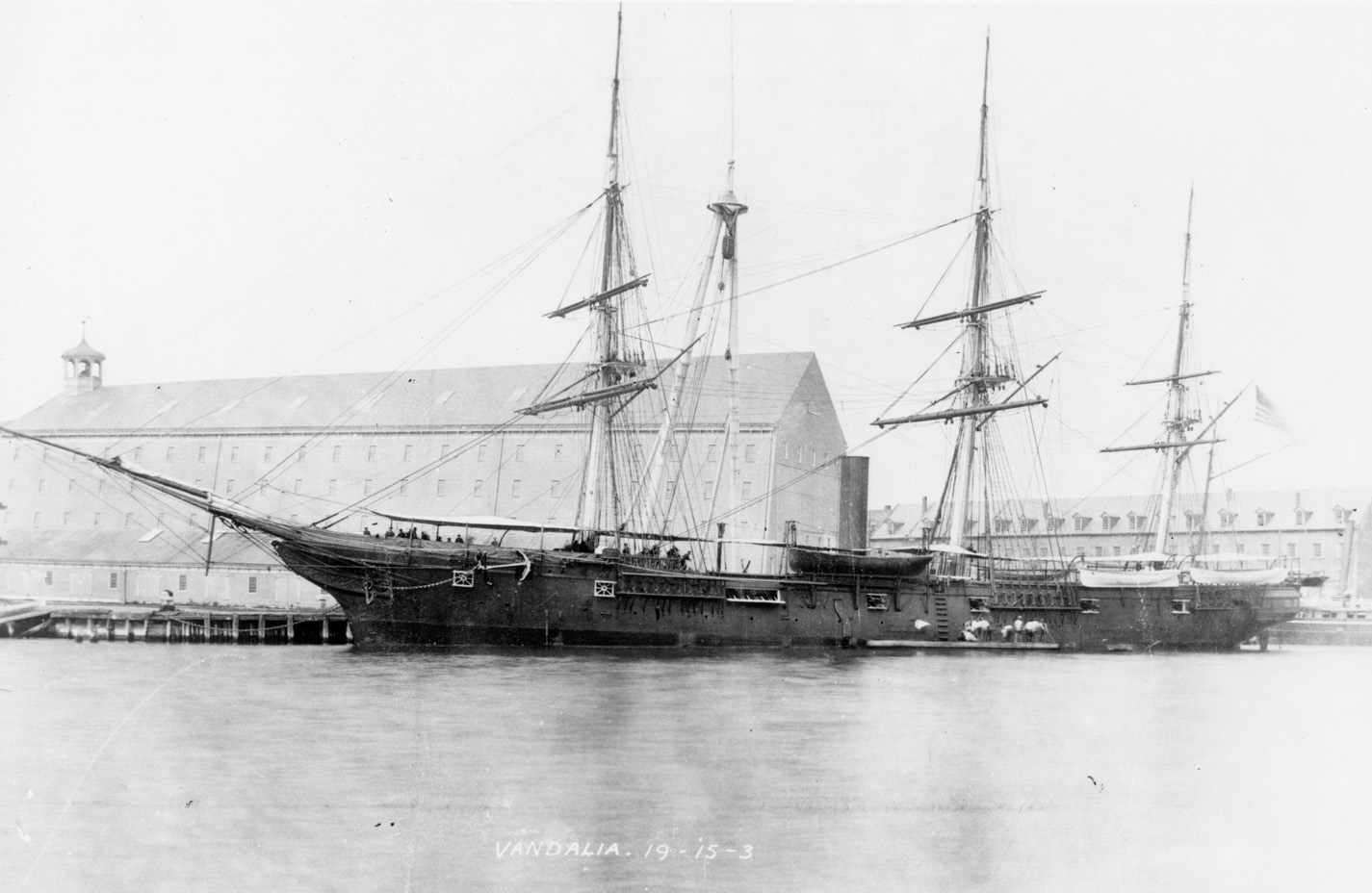
| Note: This ship was officially the sailing sloop Vandalia of 1825 "rebuilt." |
|
USS Vandalia (1874-1889) North Atlantic, European, and Pacific Stations, 1876-1889. Shown at the New York Navy Yard. Photo No. NH 58662 Source: U.S. Naval History and Heritage Command |
 |
-- Dolphin
| Note: On 3 March 1883 Congress authorized "one dispatch boat, as recommended by the Naval Advisory Board," (Dolphin) along with three cruisers (Atlanta, Boston, and Chicago). |
|
USS Dolphin (1884-1921) North Atlantic and Pacific Stations, Special Service Squadron, and Squadron of Evolution, 1885-1897. Photo No. det-4a14213 Source: U.S. Library of Congress, Detroit Publishing Co. collection |
 |
-- Yorktown Class
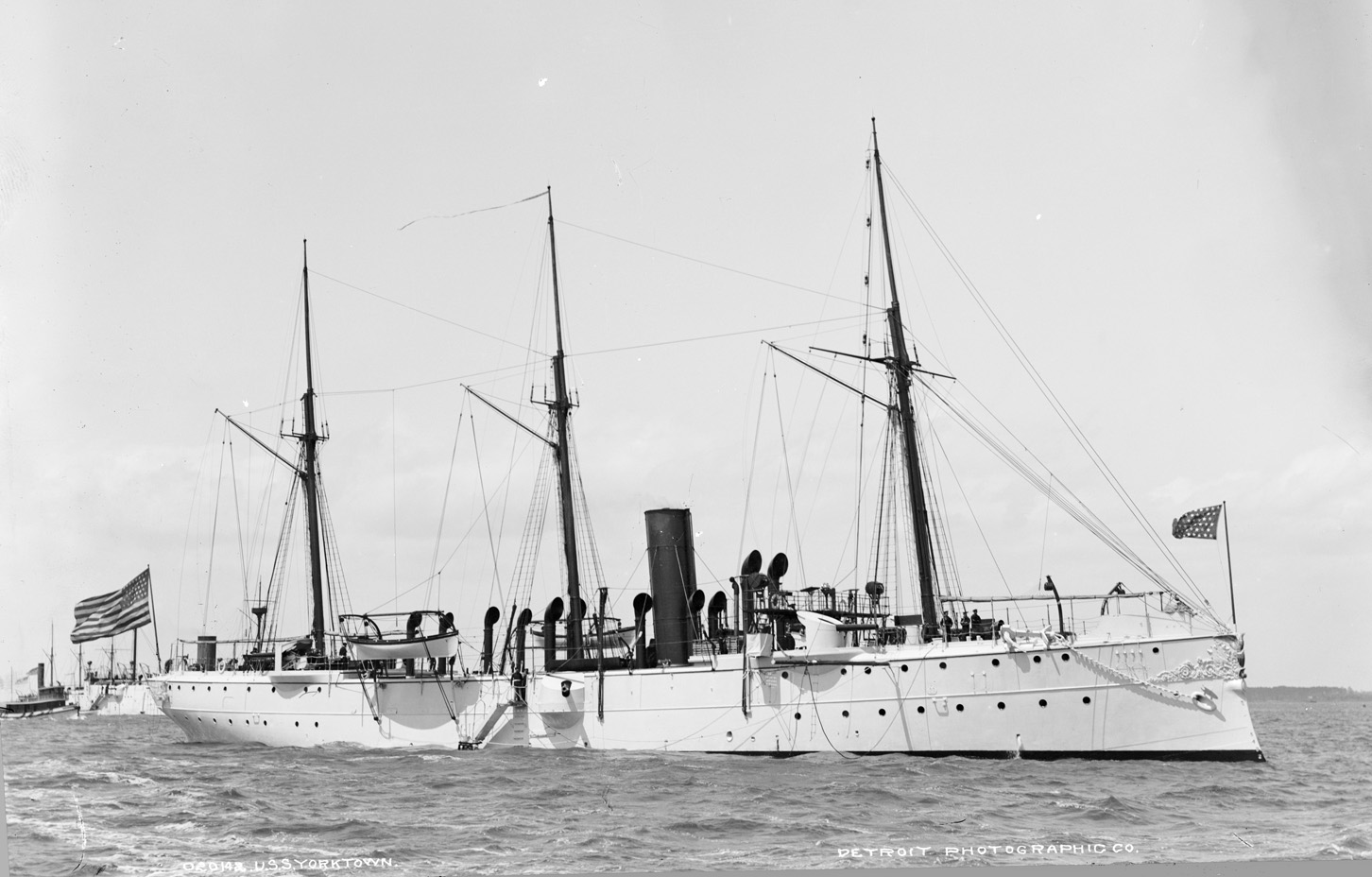
| Note: On 3 March 1885 Congress authorized "one heavily armed gunboat of about 1600 tons displacement" (Yorktown). On 3 March 1887 Congress authorized "two steel gunboats, each of about 1,700 tons displacement; of the type of gunboat number one" (Concord and Bennington). With Petrel they were an attempt to reach a minimum cruiser size consistent with seagoing efficiency and a heavy battery. They were similar to Dolphin in size but exceeded her in battery. |
|
USS Yorktown (Gunboat No. 1, 1888-1919) North Atlantic, Pacific, and Asiatic Stations, Squadron of Evolution, and Special Service Squadron, 1889-1897. The ship behind her stern being assisted by a tug may be the 2nd Rate cruiser Charleston. Photo No. det-4a14018 Source: U.S. Library of Congress, Detroit Publishing Co. collection |
 |
|
USS Concord (Gunboat No. 3, 1890-1915) Squadron of Evolution and North Atlantic, Asiatic, and Pacific Stations, 1891-1898. Funnel covers like the one shown here were in the designs for many of the early ships of the New Navy but those installed were soon removed. Photo No. 4a14192 Source: U.S. Library of Congress, Detroit Publishing Co. collection |
 |
|
USS Bennington (Gunboat No. 4, 1890-1910) Squadron of Evolution, South Atlantic, European, and Pacific Stations, and Special Service Squadron, 1891-1898. Photo No. 4a14019 Source: U.S. Library of Congress, Detroit Publishing Co. collection |
 |
-- Montgomery Class
| Note: On 7 September 1888 Congress authorized seven cruisers including "three gun-boats or cruisers, neither of which shall exceed 2,000 tons in displacement, ... to be built either wholly of steel or with steel frames" (Montgomery, Detroit, and Marblehead). The Navy set their designed speed at 18 knots, making them cruisers, before reducing it to 17 knots. Their partial protective deck was less than one inch thick, making their coal bunkers their primary protection. Like the larger Cincinnati class they were re-engined with less powerful machinery in 1900-02 and their armament was also reduced to help give them adequate stability. |
|
USS Montgomery (Cruiser No. 9, 1891-1919) North Atlantic Station, 1894-1898. Photo No. det-4a14444 Source: U.S. Library of Congress, Detroit Publishing Co. collection |
 |
|
USS Detroit (Cruiser No. 10, 1891-1910) South Atlantic, Asiatic, and North Atlantic Stations, 1893-1898. Photo No. det-4a14209 Source: U.S. Library of Congress, Detroit Publishing Co. collection |
 |
|
USS Marblehead (Cruiser No. 11, 1892-1920) North Atlantic and European Stations, 1894-1898. Photo No. det-4a14392 Source: U.S. Library of Congress, Detroit Publishing Co. collection |
 |