|
Note: Beginning in 1872 the Navy categorized its ships in four rates, 1st through 4th, which were based on displacement tonnage. Analysis of the 2nd and 3rd Rates showed that each contained two lines of development, one larger and one smaller, and this totally unofficial subdivision is used here. The break for 3rd Rates was at around 1400 tons, with none below about 700 tons. An act of Congress dated 12 June 1858 appropriated funds for eight of the ten smaller vessels with "light draft, great speed, and heavy guns" that the Secretary of the Navy had requested in 1857 for coastal work. Of these four (Mohican, Iroquois, Wyoming, and Dacotah) were to draw 13 feet, three (Narragansett, Seminole, and Pawnee) were to draw 10 feet, and one (Saginaw) was to be a paddle steamer. In 1861 SECNAV ordered the construction of four more of the 13-foot draft type (Kearsarge, Wachusett, and Tuscarora on 24 May 1861 and Oneida on 6 June 1861) as sisters to three of the original batch. The screw sloops originally had armaments of one or two large shell guns on pivots in the waist with broadside armaments limited to a few 32-pdrs. They also had full steam power for high speed and, during the war, a reduced sail rig. To carry the heavy guns and machinery on a limited draft the hulls had to be relatively large. |
-- Mohican (1) Class
|
USS Mohican (1) (1859-1873) North and South Pacific Stations, 1869-1872. Shown at the Boston Navy Yard at the end of her 1865-1866 refit, during which a small forecastle and poop may have been added. She sank at her moorings at Mare Island in 1872 and was then "rebuilt" to an entirely different design (see the Swatara (2) class). Photo No. None Source: warhistory.org/@msw/article/the-1870-torching-of-the-pirate-ship-forward-i |
 |
|
USS Kearsarge (1861-1894) Pacific, Asiatic, North Atlantic, and European Stations, 1868-1894. Shown at the Portsmouth (N.H.) Navy Yard between her postwar refit of 1871-1873 and her refit of 1886-1888 during which her rig was reduced from a ship to a bark. Photo No. NH 86060 Source: U.S. Naval History and Heritage Command |
 |
-- Iroquois Class
|
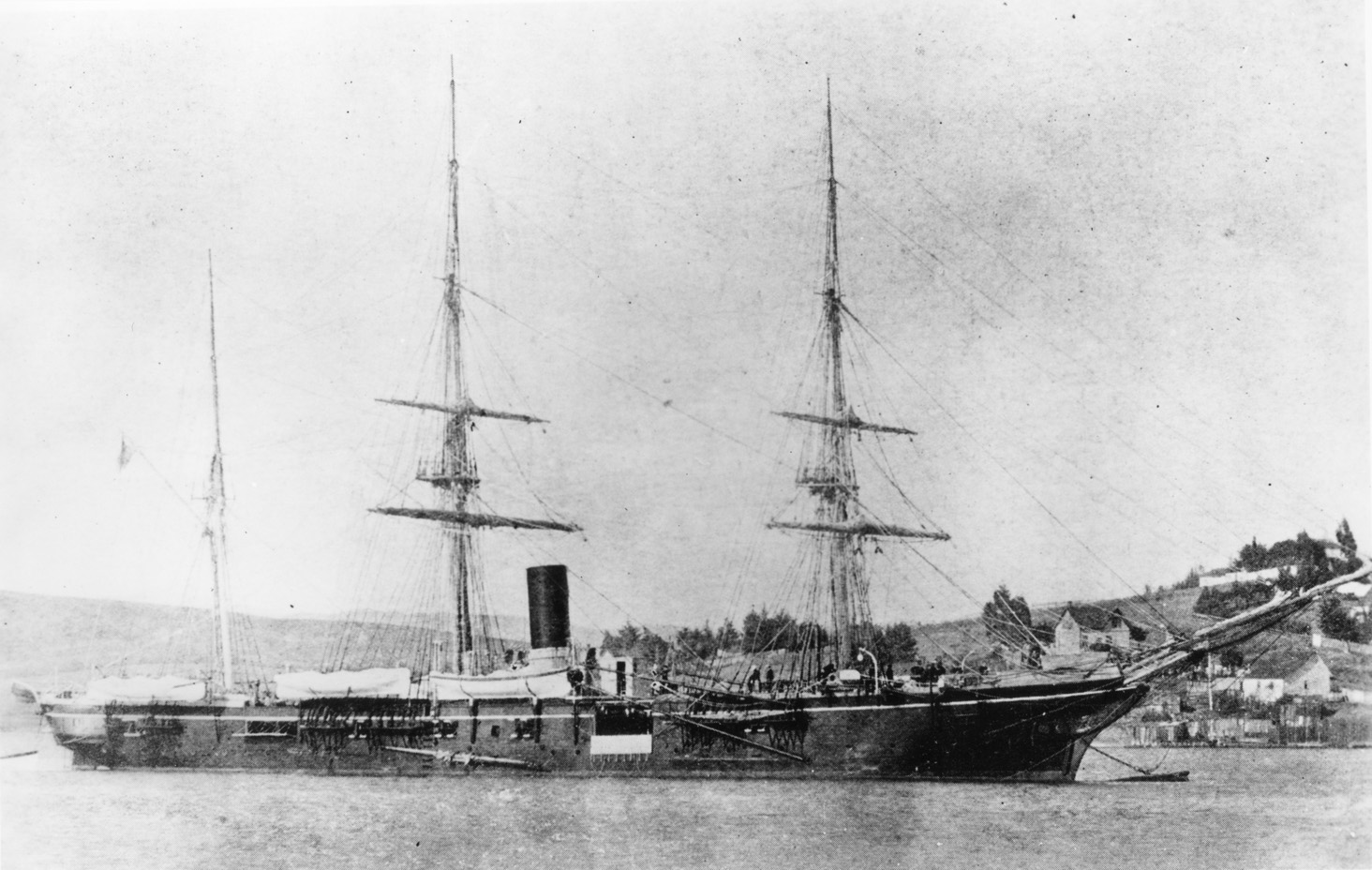
USS Iroquois (1859-1910) Asiatic and Pacific Stations, 1868-1892. Shown off Mare Island in her configuration of 1882-1892. Her hull was modified to this configuration in her refit of 1870-1871. She received her pilot house and bark rig in her refit of 1878-1882. Photo No. NH 53272 Source: U.S. Naval History and Heritage Command |
 |
|
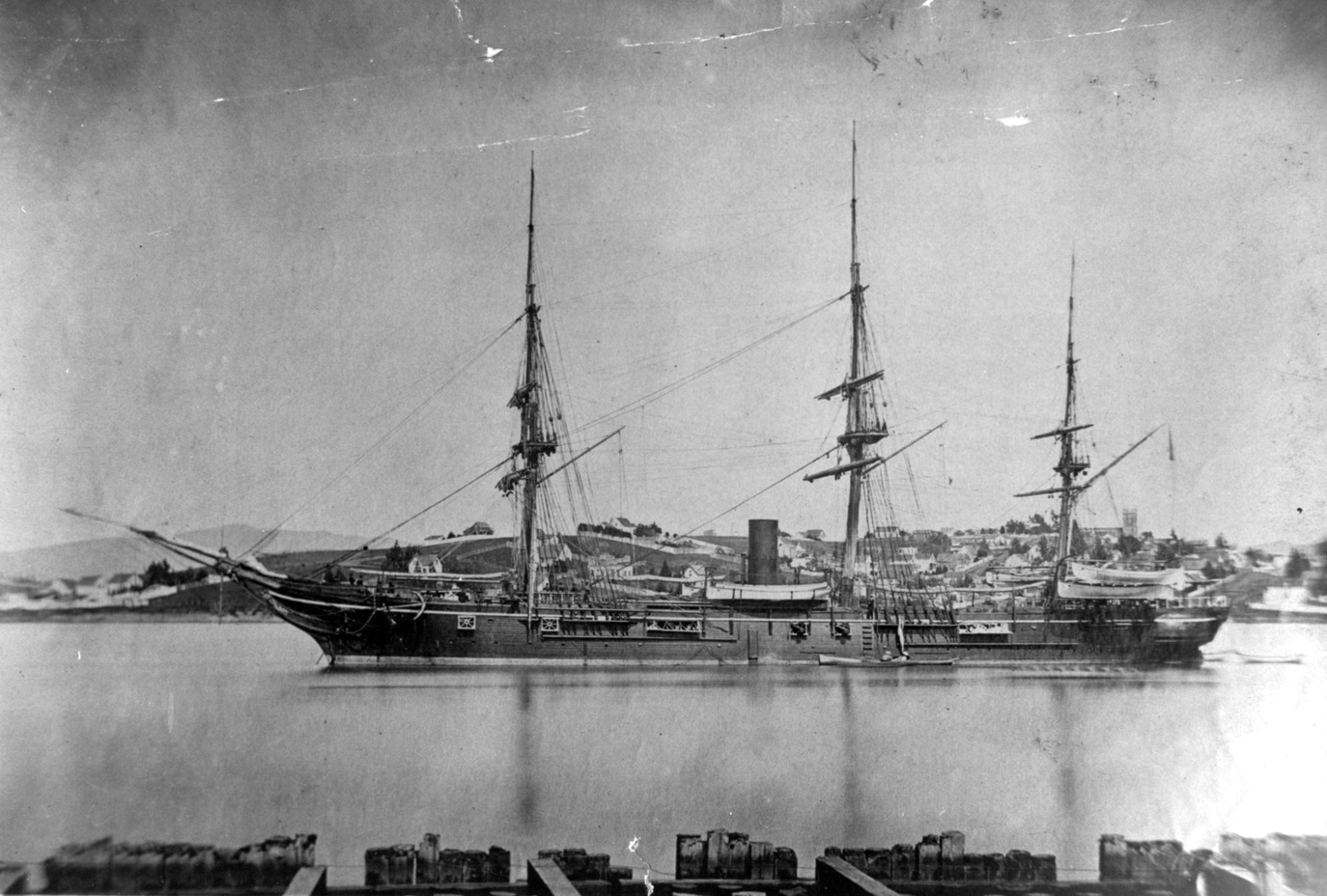
USS Wachusett (1861-1887) European, North and South Atlantic, and Pacific Stations, 1871-1885. Photographed off Mare Island after her 1878-79 refit (perhaps around 1885). From the Wm. H. Topley Collection. Photo No. NH 68681 Source: U.S. Naval History and Heritage Command |
 |
|
USS Oneida (1861-1870) Asiatic Station, 1868-1870. This drawing of unknown origin shows several features of Oneida's 1865-1867 refit, notably the wide port forward for a single 11" pivot gun and the bark rig. Her broadside armament however was only six 32-pounders and not the larger number suggested here. Photo No. NH 43064 Source: U.S. Naval History and Heritage Command |
 |
-- Wyoming Class
|
USS Wyoming (1859-1892) North Atlantic and European Stations and Special Service, 1871-1882. Photographed after her refit of 1869-1871, during which time she served as a cruiser in 1871-1874 and 1878-1882 and as a receiving ship in between. Before 1871 these two ships had bark rigs. Photo No. NH 60348 Source: U.S. Naval History and Heritage Command |
 |
|
USS Tuscarora (1861-1883) North and South Pacific and North Atlantic Stations and Special Service, 1868-1880. Photographed after her refit of 1871-1872. She had another refit in 1876-1878 at Mare Island, the probable location of this photo, during which her two pivot guns were removed. Photo No. NH 63576 Source: U.S. Naval History and Heritage Command |
 |
-- Dacotah
|
USS Dacotah (1859-1873) Pacific Station, 1868-1870. This deck view of the ship is from a stereoscopic card created between 1861 and 1863. We are looking forward, with the after pivot gun, an 11" Dahlgren, in the left foreground. The ship also had a 100-pdr Parrott rifled pivot gun forward and four 32-pdr broadside guns. She had a substantial rake to her masts and a bark rig. Her engines were removed and condemned at Mare Island in 1870 but plans to replace them were not implemented. Photo No. LC-DIG-stereo-1s04488 (right) Source: U.S. Library of Congress |
 |
-- Pawnee
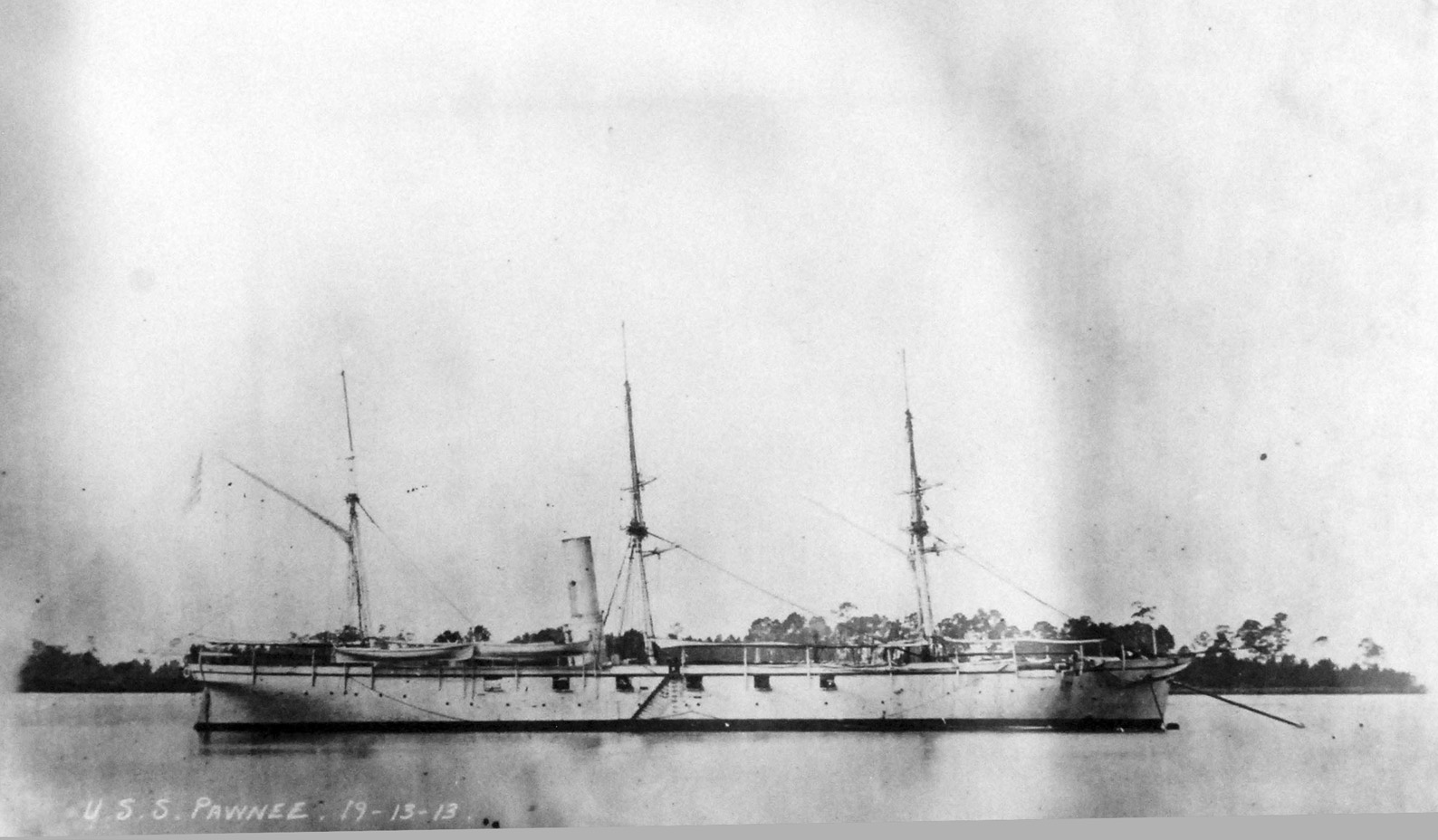
| Note: One of the three ships with a ten-foot draft funded on 12 June 1858 was designed by John W. Griffiths, a famed clipper ship designer who also created innovative shallow-draft merchant ships. He undertook to carry four 11" pivot guns on the ten-foot draft, which required a hull with a greater length and beam than any of the other 1858 sloops and other innovations like twin screws. Her machinery was poorly built and was removed in 1869, and she became a hospital ship for Key West. |
|
USS Pawnee (1859-1884) South Atlantic Station, 1868-1869. Shown while serving in the coastal waters of South Carolina, Georgia, and Florida during the Civil War. She became a sailing hospital and storeship in 1870. Photo No. 19-N-13361 Source: NARA via Flickr, National Museum of the U.S. Navy, album NARA II: 2017/09/26 |
 |
-- Ossipee Class
| Note: An Act of 21 February 1861 included seven "steam screw sloops of war of the 2nd class of not over 14' draft" for ocean service. To expedite construction three (Kearsarge, Wachusett, and Tuscarora) were built as sisters of Mohican, Iroquois, and Wyoming respectively. The other four were given increased tonnage, beam, and draft. Two of these, Adirondack and Housatonic, were lost during the Civil War. |
|
USS Ossipee (1861-1891) North and South Pacific, North Atlantic, and Asiatic Stations, 1868-1889. Shown off Honolulu, Hawaii, in 1867 after an 1865-1866 refit with her crew manning the yards. She received a ship rig and temporarily lost her forward pivot gun in an 1872-1873 refit. This photo is sometimes mis-identified as Lackawanna. Photo No. NH 51182 Source: U.S. Naval History and Heritage Command |
 |
|
USS Juniata (1862-1891) European, Asiatic, and Pacific Stations, 1869-1889. Photographed circa 1889 by E.H. Hart, New York, reflecting alterations made in a 1878-1882 refit. Photo No. NH 52369 Source: U.S. Naval History and Heritage Command |
 |