| Beginning in 1872 the Navy categorized its ships in four rates, 1st through 4th, which were based on displacement tonnage. Analysis of the 2nd and 3rd Rates showed that each contained two lines of development, one larger and one smaller, and this totally unofficial subdivision is used here. The break for 3rd Rates was at around 1400 tons, with none below about 700 tons. |
-- Adams Class
| Note: Four of these ships were authorized as new construction on 10 February 1873. The fifth, Nipsic (2), was officially the steam sloop Nipsic (1) of 1863 "rebuilt." Adams, Enterprise, and Essex were built by leading private contractors working in navy yards. Intended for general overseas cruising, primarily under sail, these gunboats had a greater beam and draft and fuller lines than their Civil War predecessors, and their new compound engines were more economical to operate than the Civil War machinery. |
|
USS Adams (1874-1920) North and South Atlantic and Pacific Stations, 1876-1898. Shown off Vallejo, Calif., in a photo copied from the journal of Naval Cadet C. R. Miller, 1898, p. 66. Photo No. NH 57279 Source: U.S. Naval History and Heritage Command |
 |
|
USS Alliance (1875-1911) North and South Atlantic, European, Asiatic, Pacific Stations, and Special Service, 1877-1898. Photographed in July 1884 airing hammocks. Photo No. NH 57126 Source: U.S. Naval History and Heritage Command |
 |
|
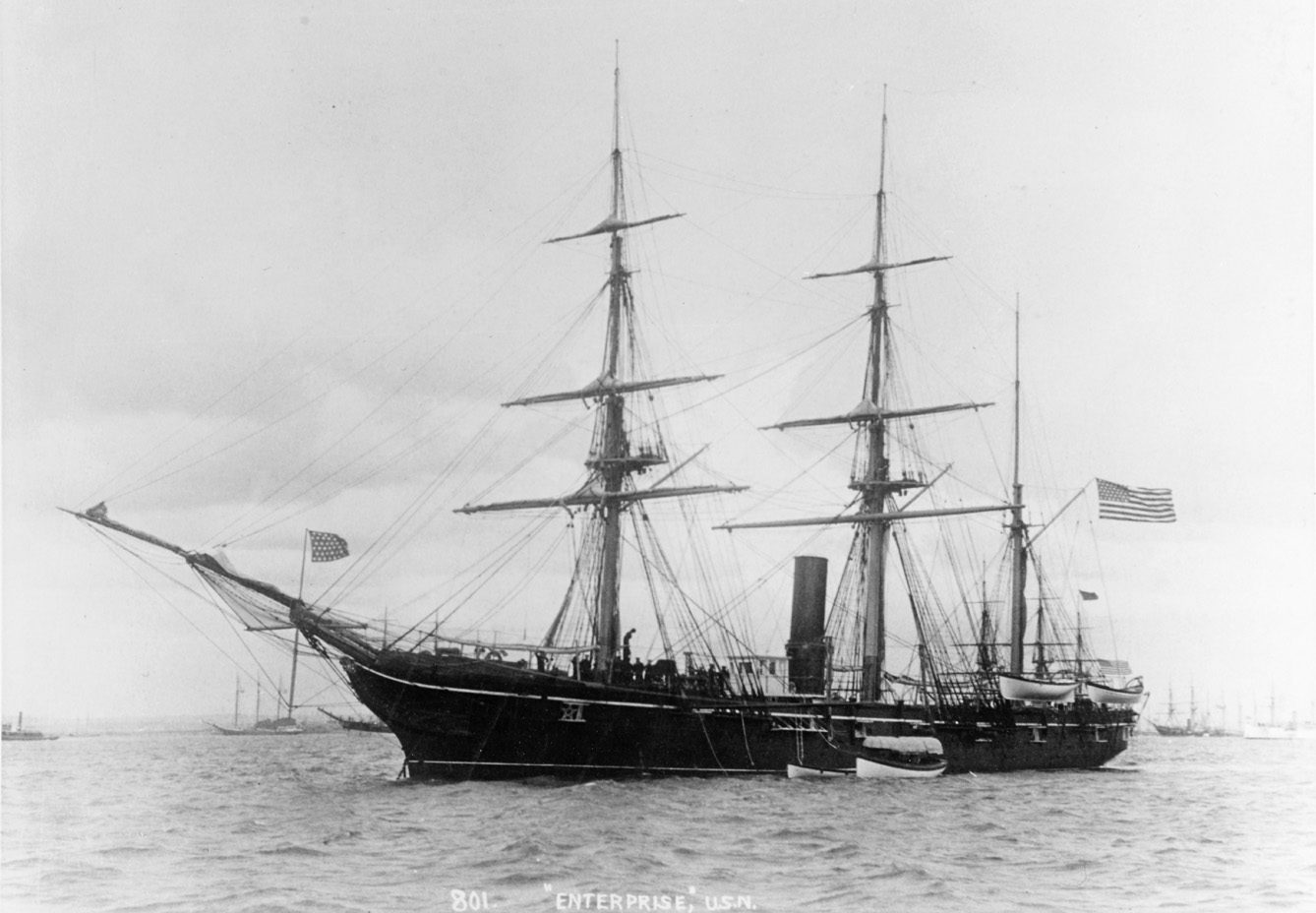
USS Enterprise (1874-1909) North Atlantic, European, and Asiatic Stations and Special Service, 1877-1891. Shown anchored off New York City during the early 1890s. Photo No. NH 63150 Source: U.S. Library of Congress, Detroit Publishing Co. collection |
 |
|
USS Essex (1874-1930) North and South Atlantic, Pacific, and Asiatic Stations, and Special Service, 1876-1898. Photographed off New York City circa 1889 drying sails. Photo No. det-4a14226 Source: U.S. Library of Congress, Detroit Publishing Co. collection |
 |
|
USS Nipsic (2) (1878-1913) North and South Atlantic, European, and Pacific Stations, 1879-1890. Shown arriving at Honolulu, Hawaii, with a jury rudder, circa August 1889. She had come up from Samoa for repair of damage received during the 15-16 March 1889 Apia hurricane. Photo No. NH 63404 Source: U.S. Library of Congress, Detroit Publishing Co. collection |
 |
-- Alert Class
| Note: Because of political pressure these gunboats were built with iron hulls. They were somewhat smaller than the wooden-hulled Adams class and originally had broadside armaments of one 9" gun per side instead of two, along with the single 11" pivot gun and single 60-pdr rifled chase gun that were in both classes. |
|
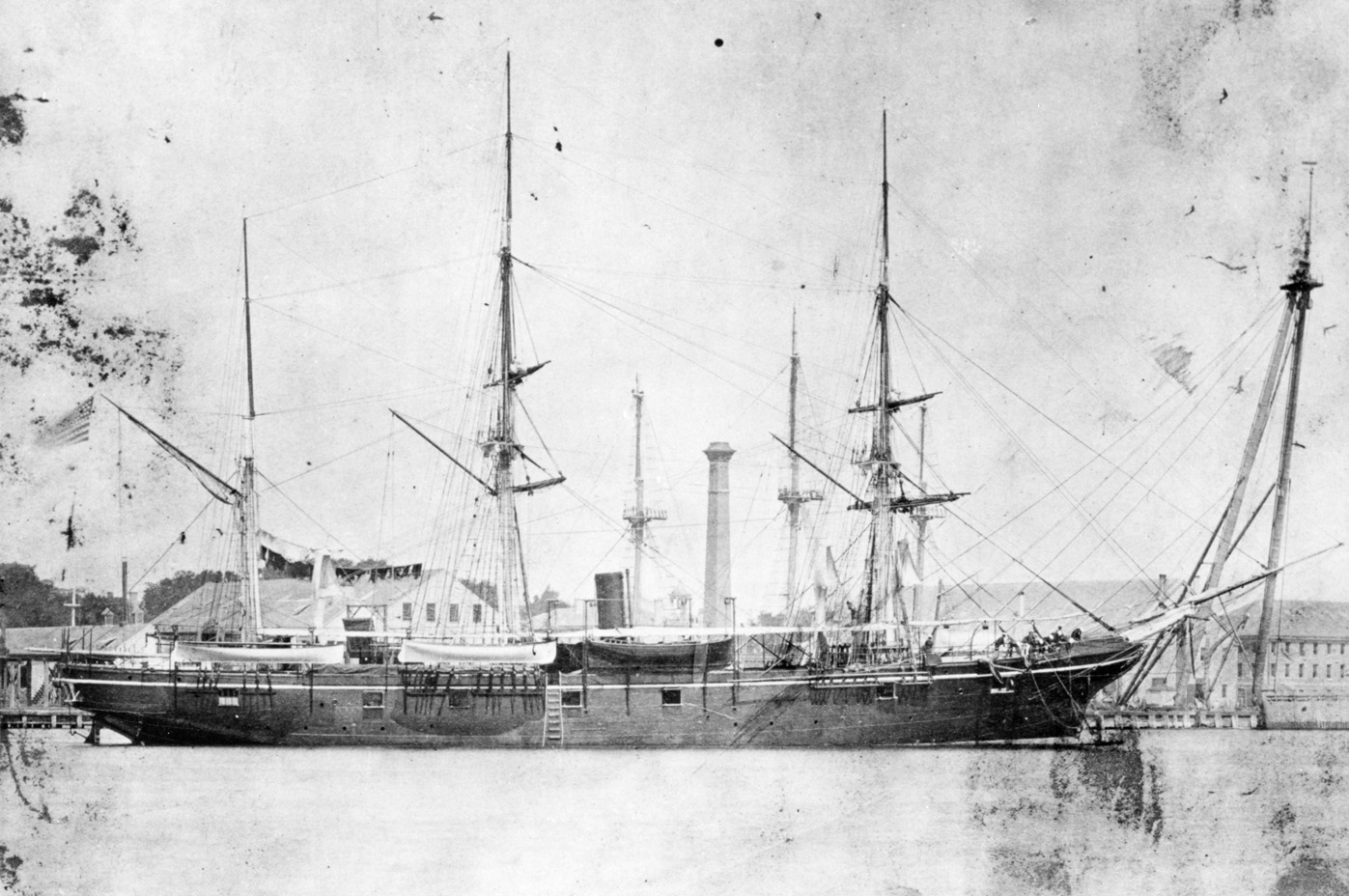
USS Alert (1874-1922) North Atlantic, Asiatic, and Pacific Stations, 1875-1898. Photographed at the Boston Navy in 1875 when new. Photo No. NH 57103 Source: U.S. Naval History and Heritage Command |
 |
|
USS Huron (1874-1877) North Atlantic Station, 1875-1877. She was lost during a storm near Nag's End, North Carolina, on 24 November 1877. Photo No. NH 93922 Source: U.S. Naval History and Heritage Command |
 |
|
USS Ranger (1876-1940) North Atlantic, Asiatic, Pacific Stations, and Special Service, 1876-1895. Bennett (Steam Navy of the U.S., 1896), the original source of this photo, states that "Originally the Ranger and Huron were fore-and-aft rigged, but after the loss of the Huron the Ranger's rig was changed to that of a bark, the same as the Alert." Photo No. NH 44604 Source: U.S. Naval History and Heritage Command |
 |
-- Thetis
| Note: On 3 March 1885 Congress authorized the Secretary of the Navy to "place the steamer Thetis for use in the Navy, as a surveying vessel or otherwise." At the same time Congress directed that Bear, also acquired for the Greely Relief Expedition, be transferred to the Treasury Department for use as a revenue cutter in the waters of Alaska. |
|
USS Thetis (1884-1916) Special Service and Pacific Station, 1887-1897. Photo shows USS Thetis in the ice off Horse Head Island, Greenland on 4 June 1884, early in the search for survivors of the Greely polar exploration party. USS Bear (later AG-29) is astern (at left). Photo No. NH 2145 Source: U.S. Naval History and Heritage Command |
 |
-- Machias Class
| Note: On 2 March 1889 Congress authorized "two steel cruisers or gun-boats of the most approved type, of 800 to 1,200 tons displacement" (Machias and Castine). The last in the series that began with Yorktown (large 3rd Rate) and Petrel (4th Rate), they were initially referred to as Cruisers Nos. 12-13, indicating the ambiguity in their design. They were larger and faster than Petrel and therefore closer to cruisers in concept, but their primary armament was made up of relatively light 4-inch guns. They were originally designed on a displacement limited by law to 800-1400 tons and were to carry eight 4" guns, two at the ends, two under the forecastle deck, two amidships and two under the poop, with a speed of 14 knots. They proved to be overgunned and top-heavy and had to be lengthened 14 feet [and ballasted] after trials. |
|
USS Machias (Gunboat No. 5, 1891-1919) Special Service and Asiatic Station, 1893-1897. Photographed circa 1893 as initially completed. Her hull was soon lengthened amidships just forward of the small middle 4" gun sponson. Photo No. NH 46901 Source: U.S. Naval History and Heritage Command |
 |
|
USS Castine (Gunboat No. 6, 1892-1920) North and South Atlantic Stations, 1894-1898. After lengthening. Photo No. det-4a14137 Source: U.S. Library of Congress, Detroit Publishing Co. collection |
 |
-- Nashville
| Note: On 3 March 1893 Congress authorized "three light-draft protected gunboats of about 1,200 tons displacement each" (Nashville, Wilmington, and Helena) for service in the Far East. Congress cited the Act of 3 March 1886 which required the use of steel. One of them (Nashville) had a full length flush deck for more enclosed volume, probably to carry troops. |
|
USS Nashville (Gunboat No. 7, 1895-1921) North Atlantic Station, 1897-1898. Photo No. NH 63415 Source: U.S. Naval History and Heritage Command |
 |
-- Wilmington Class
| Note: FY 1894. On 3 March 1893 Congress authorized "three light-draft protected gunboats of about 1,200 tons displacement each." Two of them (Wilmington and Helena) were the first specialized China gunboats. They had a limited draft of 9 feet, which would allow them to operate in river mouths but not upriver, twin screws, and large rudders for maneuverability in narrow waters. Their tall military masts provided a commanding view over the 50-foot banks and dikes of the Yangtse. Unlike Nashville they had shallow hulls with substantial forecastles extending about three quarters of their length, providing internal volume not only for crews but also for refugees and special landing parties. The stern was cut away, reducing bouyancy to improve water flow over the propellers, particularly in shallow water. |
|
USS Wilmington (Gunboat No. 8, 1895-1946) North Atlantic Station, 1897. Shown on the Orinoco River in Venezuela. Photo No. det-4a05681 Source: U.S. Library of Congress, Detroit Publishing Co. collection |
 |
|
USS Helena (Gunboat No. 9, 1896-1932) North Atlantic Station, 1897. Photo No. det-4a13896 Source: U.S. Library of Congress, Detroit Publishing Co. collection |
 |
-- Annapolis Class
| Note: FY 1895: 6 gunboats. All had composite hulls (steel above the waterline, wood below). The Navy invited bids on two variants (alternative approaches to balancing speed and endurance), a single screw gunboat with full sail power (barkentine rig) and a twin screw steamer with steadying sails only. Both had to make 12 knots. The non-sail variant carried 120 more tons of coal, while the sail variant had to be longer to carry the sails. The four barkentines were built on the east coast and the two steamers by Union Iron Works on the west coast. The fourth barkentine, Princeton (Gunboat No. 13), was still building in 1897. |
|
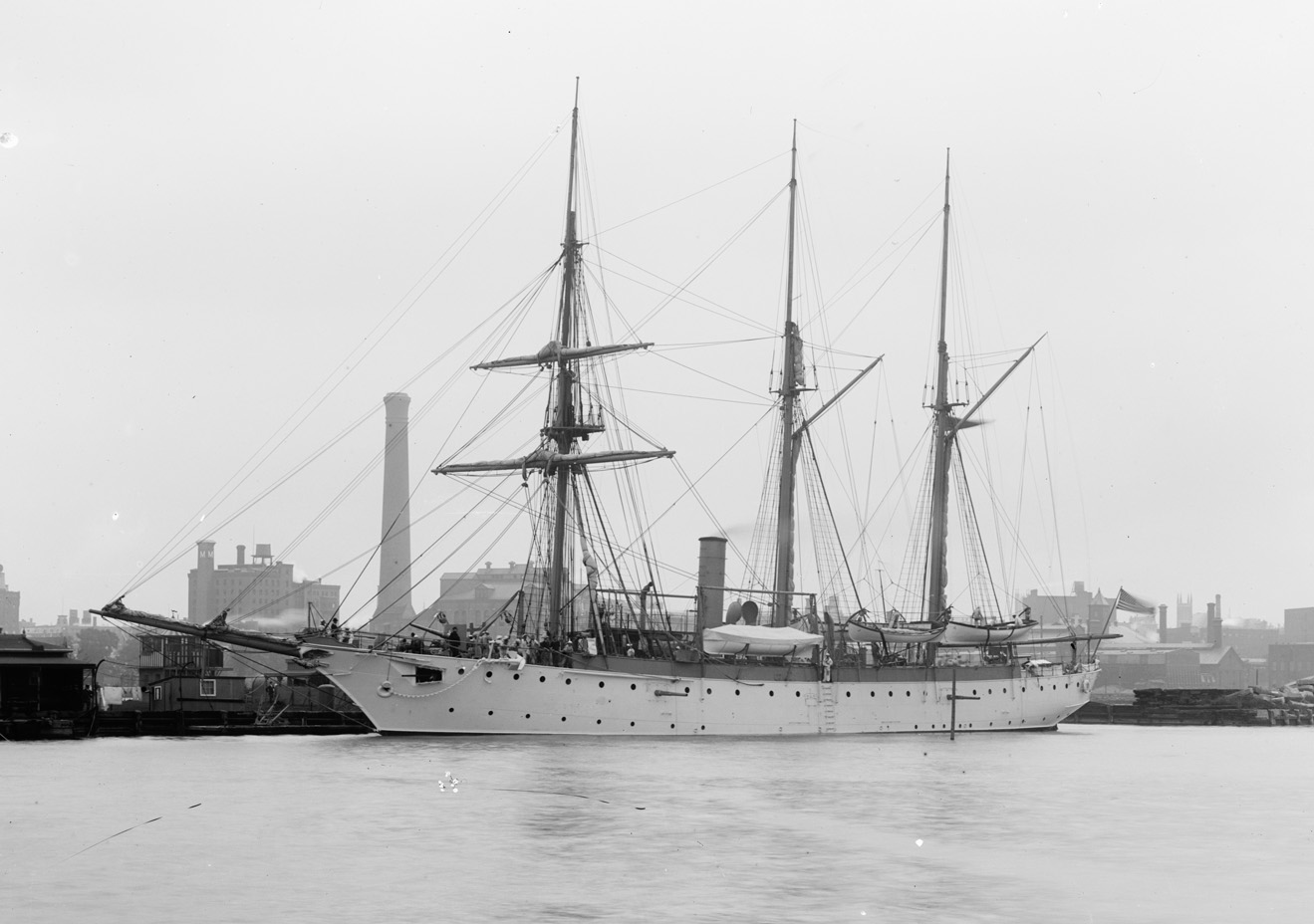
USS Annapolis (Gunboat No. 10, 1896-1940) North Atlantic Station, 1897-1898. Photo No. det-4a13878 Source: U.S. Library of Congress, Detroit Publishing Co. collection |
 |
|
USS Vicksburg (Gunboat No. 11, 1896-1921) North Atlantic Station, 1897-1898. Photo No. NH 44258 Source: U.S. Naval History and Heritage Command |
 |
|
USS Newport (Gunboat No. 12, 1896-1931) North Atlantic Station, 1897. Photo No. NH 45124 Source: U.S. Naval History and Heritage Command |
 |
-- Wheeling Class
| Note: FY 1895. These are the twin screw steamers with steadying sails mentioned above. |
|
USS Wheeling (Gunboat No. 14, 1897-1946) Pacific Station, 1897-1898. With a Borden's milk wagon on the pier aft. Photo No. ggbain-4a08959 Source: U.S. Library of Congress, Bain News Service collection |
 |
|
USS Marietta (Gunboat No. 15, 1897-1920) Pacific Station, 1897-1898. At the New York Navy Yard circa 1902. Photo No. 19-N-12-19-12 Source: U.S. Naval History and Heritage Command (from NARA RG-19) |
 |