| Beginning in 1872 the Navy categorized its ships in four rates, 1st through 4th, which were based on displacement tonnage. Analysis of the 2nd and 3rd Rates, however, showed that each contained two lines of development, one larger and one smaller, and this totally unofficial subdivision is used here. The break for 3rd Rates was at around 1400 tons, with none below about 700 tons. |
-- Narragansett Class
| Note: An act of Congress dated 12 June 1858 appropriated funds for eight ships for coastal work including three (Narragansett, Seminole, and Pawnee) that were to draw only 10 feet and one side-wheel steamer "for services in the East India Squadron" (Saginaw). Three of these (all but Pawnee) had tonnages below 2000 tons which beginning in 1872 would have put them in the 3rd rate. |
|
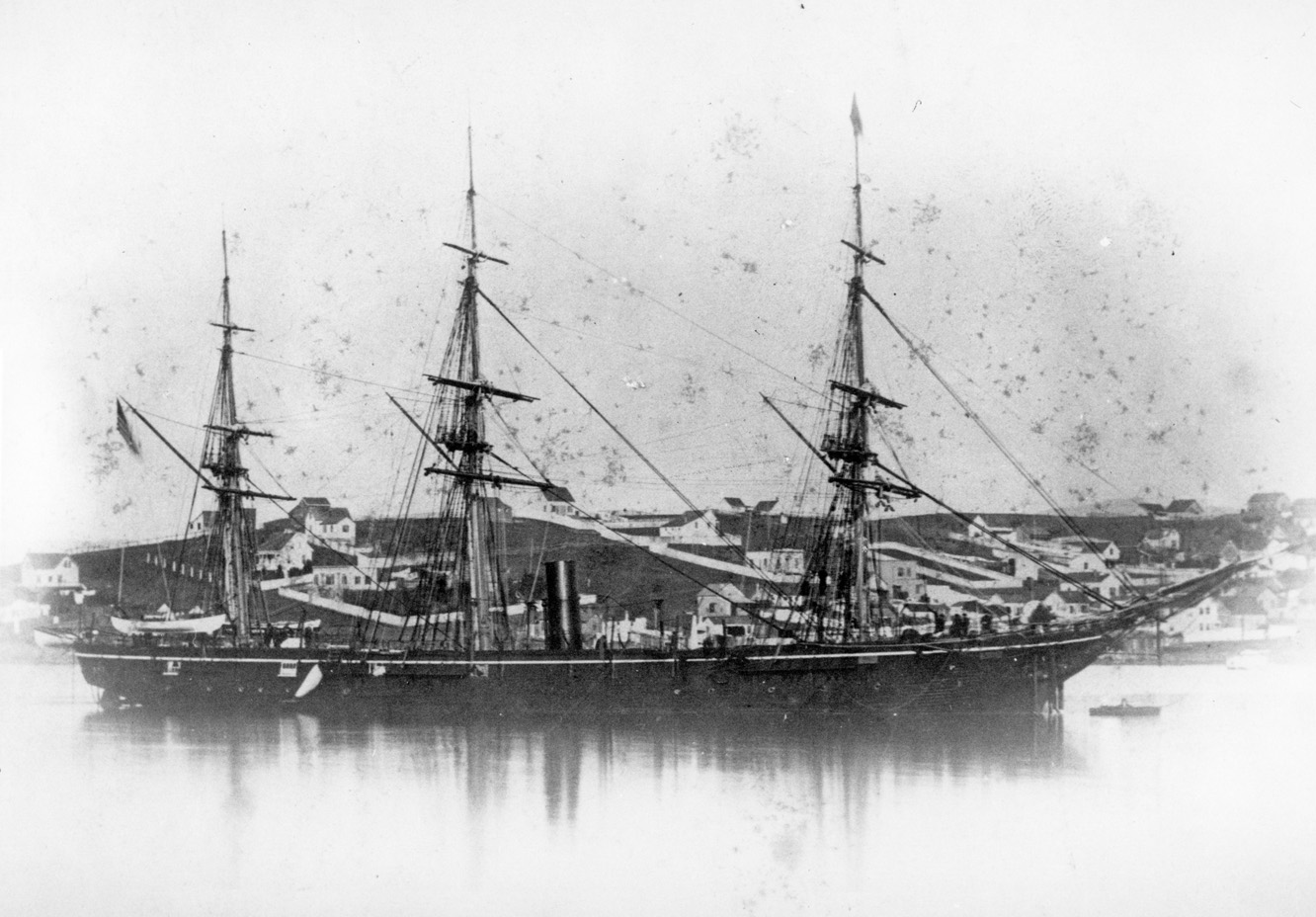
USS Narragansett (1859-1883) North Atlantic, Pacific Stations, and Special Service, 1869-1875. Photographed at Mare Island, probably while under the command of Cdr. George Dewey on surveying service, 1873-1875. New boilers were ordered for her in 1877 but cancelled. Photo No. NH 93242 Source: U.S. Naval History and Heritage Command |
 |
|
USS Seminole (1859-1870) North Atlantic Station, 1869-1870. "Attack on the U.S. steam sloop-of-war Seminole, from the rebel batteries, Evansport, Shipping Point, Potomac River, October 15." From Leslie's Illustrated, 2 November 1861. Recommissioned after the war in April 1869, she was decommissioned in February 1870 and sold. Photo No. NH 45363 (detail) Source: U.S. Naval History and Heritage Command |
 |
-- Saginaw
| Note: This ship was ordered on 17 July 1858 from the Mare Island Navy Yard as a side wheel steamer "intended for service in the China seas, whose greatest draft of water shall not exceed eight feet." She was to be armed with a 32-pdr gun on a pivot and two boat guns, which became 24-pdr broadside guns. The plans were drawn at Mare Island. |
|
USS Saginaw (1859-1870) Pacific Station, 1868-1870. This photo, possibly the only one of this ship, first appeared in The Last Cruise of the Saginaw by George H. Read (1912). Photo No. NH 2012 Source: U.S. Naval History and Heritage Command |
 |
-- Aroostook Class
| Note: Upon the outbreak of the Civil War the Navy ordered 23 of these "90-day gunboats" as an emergency measure. Although useful in blockading the mouths of the lesser Southern rivers and harbors, they were built of poorly seasoned wood and all were sold before 1870. |
|
USS Aroostook (1861-1869) Asiatic Station, 1869. Found unfit and sold 1869. Photo No. NH 57274 Source: U.S. Naval History and Heritage Command |
 |
|
USS Penobscot (1861-1869) North Atlantic Station, 1869. No illustrations. The photo is of a sister, USS Marblehead, which was sold in 1868. Photo No. NH 46630 Source: U.S. Naval History and Heritage Command |
 USS Marblehead USS Marblehead |
|
USS Unadilla (1861-1869) Asiatic Station, 1868-1869. Shown with a sister behind her. Found unfit in 1869, she was sold at Hong Kong to the government of Annam as a warship but was sunk in collision in 1870. Photo No. None Source: Wikipedia |
 |
-- Galena (1)
| Note: This ship was built with interlocking "rail and plate" armor designed by Samuel H. Pook that failed in its first engagement on 15 May 1862. A year later, on 13 May 1863, the Philadelphia Navy Yard was ordered to remove the armor except around the engines and boilers, and on 13 February 1864 the ship was recommissioned as a sloop of war with eight 9" and one 100pdr rifle and a three-masted barkentine rig. Decommissioned on 17 June 1865 at the Portsmouth (N.H.) Navy Yard, she was recommissioned on 9 April 1869 for movement to Hampton Roads, where she was decommissioned on 2 June 1869 and condemned by a board of survey in 1870. |
|
USS Galena (1) (1862-1871) North Atlantic Station, 1869 (for transit between navy yards). Photo No. None Source: Century Co. |
 |
-- Yantic Class
| Note: These ships were built as "fast cruising gunboats" after experience with the 90-day gunboats on blockade duty showed a need for greater speed. They had two masts, a light schooner rig, and straight bows as shown in the wartime view of Kansas, below. The six ships had four different types of engines. Five of them, excluding Nyack, were rebuilt with clipper bows and three masts circa 1869 on the orders of Admiral Porter. |
|
USS Kansas (1863-1883) South and North Atlantic Stations, 1868-1875. This ship was added to the Yantic class to use a set of English engines captured in a blockade runner. She is shown here in her original Civil War configuration in a merged image from two on a stereoscopic card. Photo No. LC-02188 and 02189 merged Source: U.S. Library of Congress, Detroit Publishing Co. collection |
 |
|
USS Nyack (1863-1883) Pacific Station, 1868-1871. No illustrations. She was neither rearmed nor refitted after the Civil War and would have resembled this image of USS Nipsic (1) by the Major & Knapp Engraving, Manufacturing, and Lithographic Company, 71 Broadway, New York, that was drawn by M. B. Woolsey, U.S.N. Printed in color between 1867 and 1872, it shows the ship before 1869 with a vertical bow, two masts, and an armament of one 11" pivot gun and two 8" or 9" guns. Photo No. None Source: From the ship's source file in the NHHC Ship Histories Branch |
 USS Nipsic (1) USS Nipsic (1) |
|
USS Nipsic (1) (1863-1875) North Atlantic Station and Special Service, 1868-1873. This is either Nipsic (1) in her configuration of 1869-1873 or Yantic in her configuration of 1872-1897. She is shown at the Washington Navy Yard (where Nipsic was rebuilt in 1869) with the West Shiphouse behind her. Nipsic (1) was broken up in 1875 and then "rebuilt" to an entirely different design (see the Adams class). Photo No. NH 45212 Source: U.S. Naval History and Heritage Command |
 |
|
USS Saco (1863-1883) European and Asiatic Stations, 1870-1876. Shown in her configuration of 1870-1876 with a clipper bow and three masts. She had 14 boilers with two tall funnels instead of the two boilers and one funnel in her sisters, the contractor (Corliss) desiring to keep all of the steam generators below the waterline. These failed and were replaced with four boilers and the two shorter funnels shown here at the Washington Navy Yard in 1865-66. Photo No. NH 45210 Source: U.S. Naval History and Heritage Command |
 |
|
USS Shawmut (1863-1883) North Atlantic Station, 1871-1877. Shown off Giesboro Point in the Potomac River near Washington, D.C. Photo No. NH 58770 Source: U.S. Naval History and Heritage Command |
 |
|
USS Yantic (1864-1929) North and South Atlantic, Asiatic, Stations, and Special Service, 1868-1897. This, the first of the class to be ordered and by far the longest lived, is shown in her configuration of 1872-1897. Photo No. NH 63152 Source: U.S. Naval History and Heritage Command |
 |
-- Maumee Class
| Note: The two ships of the Maumee class were built to plans identical to some developed by William H. Webb for an unidentified Russian government steamer except that they lacked a bowsprit. They added two more types of engines to the four in the Yantic class. They and Nyack of the Yantic class were sold out of service without being rebuilt with clipper bows and three masts as were the rest of the Yantic class. |
|
USS Maumee (1863-1869) Asiatic Station, 1868-1869. Found unfit in China 1869. No illustrations. This drawing is of Maumee's single sister Pequot, which was laid up immediately after the war and sold to Haiti in 1869 as their Terreur. They had two masts as shown here but never had clipper bows, their bows being straight like the original bow of Kansas, above, but raked rather than nearly vertical. Photo No. NH 45213 Source: U.S. Naval History and Heritage Command |
 USS Pequot USS Pequot |
-- Monocacy Class
| Note: These ships, the final version of the Civil War double-ended paddle gunboats, were ordered in 1863 with iron instead of wood hulls, giving them strength sufficient for sea service as well as coastal work. The last one launched, Ashuelot, was converted to a single-ender during construction. |
|
USS Monocacy (1864-1903) Asiatic Station, 1868-1898. Photo No. NH 61702 Source: U.S. Naval History and Heritage Command |
 |
|
USS Mohongo (1864-1870) Asiatic Station, 1868-1869. Sold in 1870. Photo No. NH 44803 Source: U.S. Naval History and Heritage Command |
 |
|
USS Ashuelot (1865-1883) Asiatic Station, 1868-1883. Wrecked on Lamock Rocks, China, on 18 February 1883. Photo No. NH 105802 (detail) Source: U.S. Naval History and Heritage Command |
 |
-- Resaca Class
| Note: The Resaca and Swatara classes were follow-ons to the Yantic class, with the same beam and internal layout but 36' more length for increased speed as fast gunboats. The Resaca class had finer lines forward than the Swatara class and a rounder midsection. Resaca was fitted with a vertical bow as designed but Nantasket was modified during construction with a clipper bow. |
|
USS Resaca (1865-1873) Pacific Station and Special Service, 1869-1872. Photo No. NH 93920 Source: U.S. Naval History and Heritage Command |
 |
|
USS Nantasket (1867-1875) North Atlantic Station, 1869-1872. No illustrations. Comparison with ship plans in the National Archives shows that this photo, identified by an old caption as Nantasket and often so cited, is actually either Wyoming or Tuscarora before they received ship rigs in 1871-1872 in place of the bark rig shown here. The form of both the bow and stern of these two larger ships is unmistakable. Photo No. NH 45368 Source: U.S. Naval History and Heritage Command |
 Wyoming Class Wyoming Class |
-- Swatara (1) Class
| Note: Quinnebaug was added to the class to receive twin screw machinery by Jackson & Watkins of London for comparative trials with the Navy's machinery. Two more ships like Swatara were cancelled. Swatara and Quinnebaug were completed as designed with vertical bows, and Swatara was refitted with a clipper bow in 1869. Quinnebaug's English machinery proved unsatisfactory and instead of being reengined she was broken up and "rebuilt" to a new design (see the Swatara (2) class). |
|
USS Swatara (1) (1865-1872) European and North Atlantic Stations, 1869-1871. John H. Surratt, an accomplice of John Wilkes Booth, was placed on the United States war-steamer Swatara at Alexandria, Egypt, on 21 December 1866 and was taken from the ship at the Washington Navy Yard on 19 February 1867 as shown here in Harper's Weekly. Note her straight bow, three masts, and the two monitors behind her. Photo No. None Source: Harper's Weekly, 9 March 1867, page 149 |
 |
|
USS Quinnebaug (1) (1866-1871) South Atlantic Station, 1868-1870. |
|