| Beginning in 1872 the Navy categorized its ships in four rates, 1st through 4th. The first three rates were based on displacement tonnage while the fourth rate was initially a miscellaneous collection of small vessels beginning with a wooden double-ender serving as a dispatch vessel, three former paddle blockade runners, two converted tugs, and a screw dispatch vessel. The largest of these was Tallapoosa at 1173 tons and the smallest Pinta at 450 tons. |
-- Tallapoosa
|
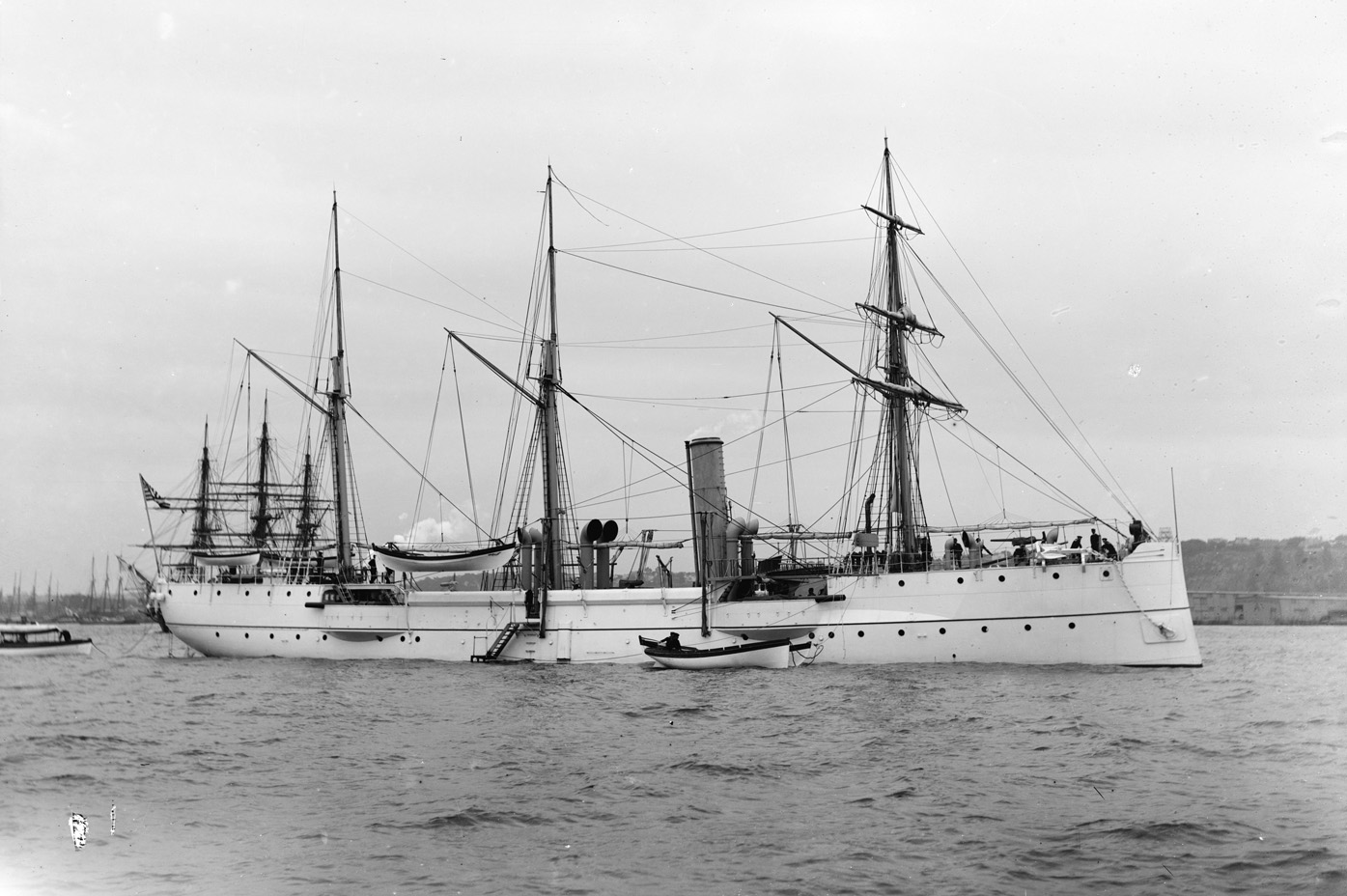
USS Tallapoosa (1863-1892) Special Service and South Atlantic Station, 1869-1892. She is shown here after being rebuilt as a single-ended dispatch vessel in 1874-1875 and again in 1884-1885. She served on the South Atlantic Station in this configuration. Note the ample quarters aft for passengers. Photo No. NH 43864 Source: U.S. Naval History and Heritage Command |
 |
-- Gettysburg
|
USS Gettysburg (1864-1879) North Atlantic Station and Special Service, 1868-1879. Painting by De Simone depicting this former blockade runner underway in the Bay of Naples, Italy, in 1878. If she ever had two funnels, as shown in a painting of her under her original name, Douglas, the forward one was gone before the Navy captured the ship. She was known for her straight rather than clipper bow. Photo No. NH 53730 Source: U.S. Naval History and Heritage Command |
 |
-- Frolic
|
USS Frolic (1864-1877) European and South Atlantic Stations and Special Service, 1868-1877. The former blockade runner is shown moored at Naples, Italy, circa 1868-1869, with over her stern the bows of Italian naval ships including the small paddle aviso Peloro, the ironclad Terribile, and the transport Rosalino Pilo. Another American ship is quayside at the extreme lower left. Photo No. NH 53957 Source: U.S. Naval History and Heritage Command |
 |
-- Wasp
|
USS Wasp (1865-1876) South Atlantic Station, 1868-1876. Originally the blockade runner Emma Henry, she was captured on 10 December 1864, commissioned on 11 May 1865, and renamed Wasp during repairs on 13 June 1865. She was sent to the South Atlantic Station to navigate the Paraná and Paraguay rivers during the Paraguayan War, 1864-1870. In this drawing of unknown origin, the double-ender is Shamokin and the two-masted gunboat with a clipper bow is Huron. These were both on station with Wasp between early 1867 and late 1868. Photo No. None (from the CivilWarTalk forum) Source: civilwartalk.com/threads/uss-wasp.155787/ |
 |
-- Palos
|
USS Palos (1865-1893) Asiatic Station, 1870-1893. Anchored in the Han River, Korea, in May-June 1871, showing early alterations for use as a small crusing gunboat. During this punative operation she towed barges of the landing party during landing operations on 10 June 1871. By 1884 she had been built up further, in the same manner as Pinta, below. See her page on this site here. Photo No. 19-N-12842 Source: U.S. National Archives, RG-19-N box 32 |
 |
-- Pinta
|
USS Pinta (1864-1908) Pacific Station, 1884-1897. She was built up in 1881-1883 with a complete covered deck level above her low tugboat hull for service in Alaska (based at Sitka) and is shown here in Juneau Harbor, Alaska, in 1889. See her page on this site here. Photo No. NH 63311 Source: U.S. Naval History and Heritage Command |
 |
-- Despatch
|
USS Despatch (1873-1891) North Atlantic Station and Special Service, 1873-1891. She was built in 1873 as Americus, the "largest and handsomest yacht afloat," by George Steers of Brooklyn, N.Y. for a New York stockbroker who was soon forced by the financial panic of September 1873 to sell her to the Navy at a bargain price. She is shown here moored at the Norfolk Navy Yard. The height of her funnel was later reduced, possibly when her boilers were replaced in 1879-80. The new Dolphin replaced her in 1891. Photo No. NH 54501 Source: U.S. Naval History and Heritage Command |
 |
-- Petrel
| Note: On 3 March 1885 Congress authorized "one light gunboat of about 800 tons displacement" (Petrel), along with the "heavily armed gunboat" Yorktown. Being smaller than Yorktown, Petrel with four 6" guns and a speed of only 11.5 knots came closer to the gunboat concept of the 1881 Naval Advisory Board. |
|
USS Petrel (Gunboat No. 2, 1888-1920) North Atlantic and Asiatic Stations, 1889-1898. Photographed by E.H. Hart of New York circa the early 1890s. Photo No. det-4a13974 Source: U.S. Library of Congress, Detroit Publishing Co. collection |
 |