| Beginning in 1872 the Navy categorized its steamers in four rates, 1st through 4th. It also divided its remaining sailing ships into rates but on a different scale: 2nd Rate (4000 tons and above, effectively ships of the line), 3rd Rate 1st Class (1800-3500 tons), 3rd Rate 2nd Class (1800 tons and below), and 4th Rate (auxiliaries). |
Sailing Sloops of War
-- Portsmouth
|
USS Portsmouth (1843-1915) South Atlantic and North Pacific Stations and Special Service, 1869-1876. 3rd Rate, 2nd Class, 15 guns, 1125 tons, in 1872. This Civil War vintage photo is from Miller, Photographic History of the Civil War, vol. 6, p. 182. Portsmouth was on the Gulf Blockading Squadron until May 1862 and then became station ship at New Orleans for the rest of the war. The screw steamer ahead of her is identified in a contemporary caption as the "French steamer Milano," but is not the French Navy's Milan which was a paddle aviso. Portsmouth landed her armament at Washington D.C. on 26 February 1878 and became a training ship. Photo No. NH 49982 Source: U.S. Naval History and Heritage Command |
 |
-- Jamestown
|
USS Jamestown (1844-1912) Pacific Station and Special Service, 1869-1881. 3rd Rate, 2nd Class, 16 guns, 1150 tons, in 1872. This photo from Miller, Photographic History of the Civil War, vol. 6, p. 119 is probably of Civil War vintage. Jamestown was ordered to the East Indies on 11 September 1862 and remained there until after the war's close. After serving as a transport and store ship with four guns in 1866-68 she was rearmed with 16 guns for more cruising duty in 1869. Photo No. NH 52175 Source: U.S. Naval History and Heritage Command |
 |
-- St. Marys
|
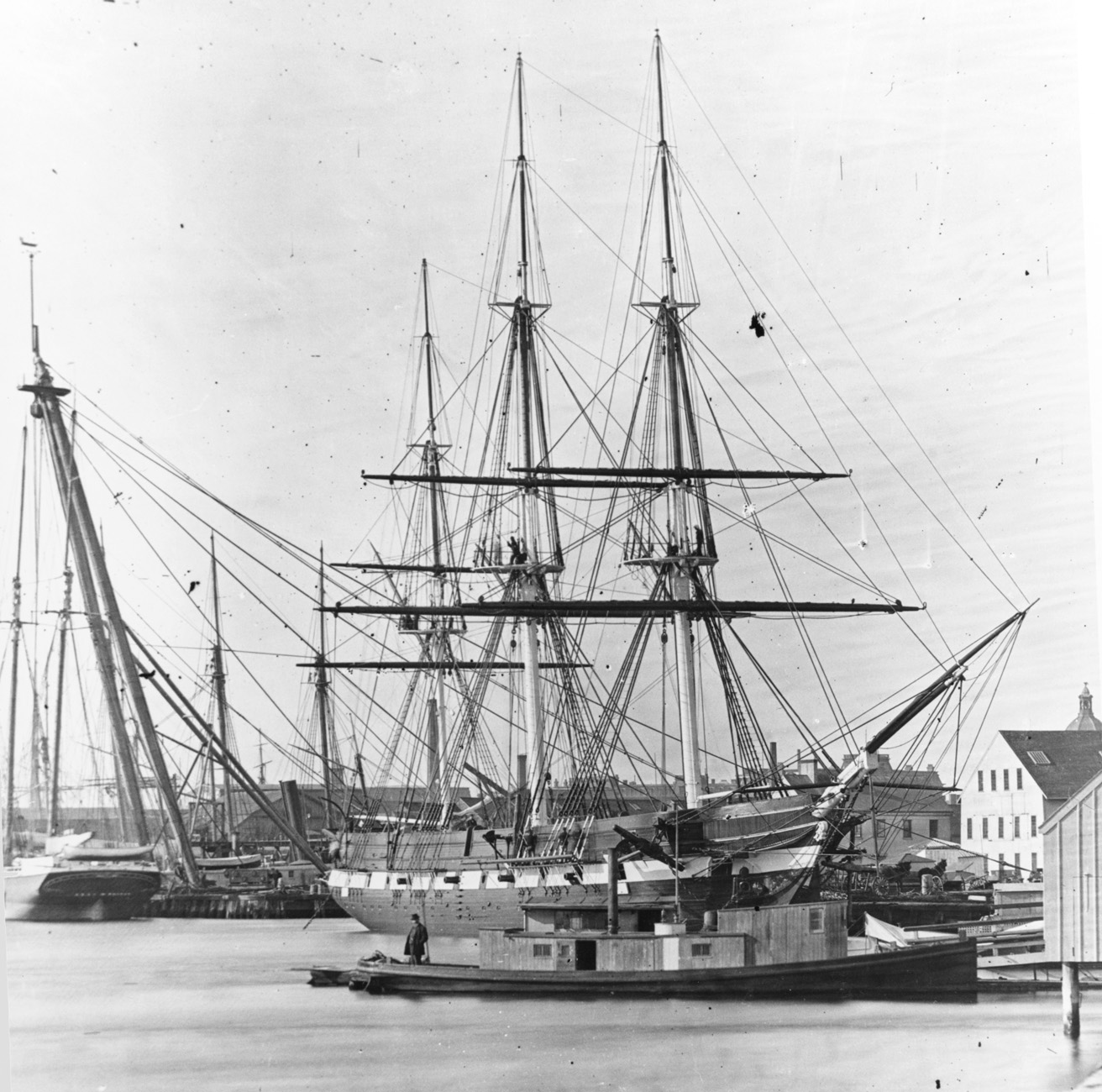
USS St. Marys (1844-1908) Pacific Station, 1870-1873. 3rd Rate, 2nd Class, 16 guns, 1025 tons, in 1872. She was recommissioned in 1870 with 14-8"shell guns and 2-60pdr Parrott rifles for Pacific cruising. In 1876 she became a training ship for the New York Nautical School at New York, and she is shown here early in her training career with the eight 8" guns that she kept in her battery until 1890. Photo No. 19-N-19-1-8 Source: U.S. Naval History and Heritage Command from NARA |
 |
Store Ships
-- Relief
|
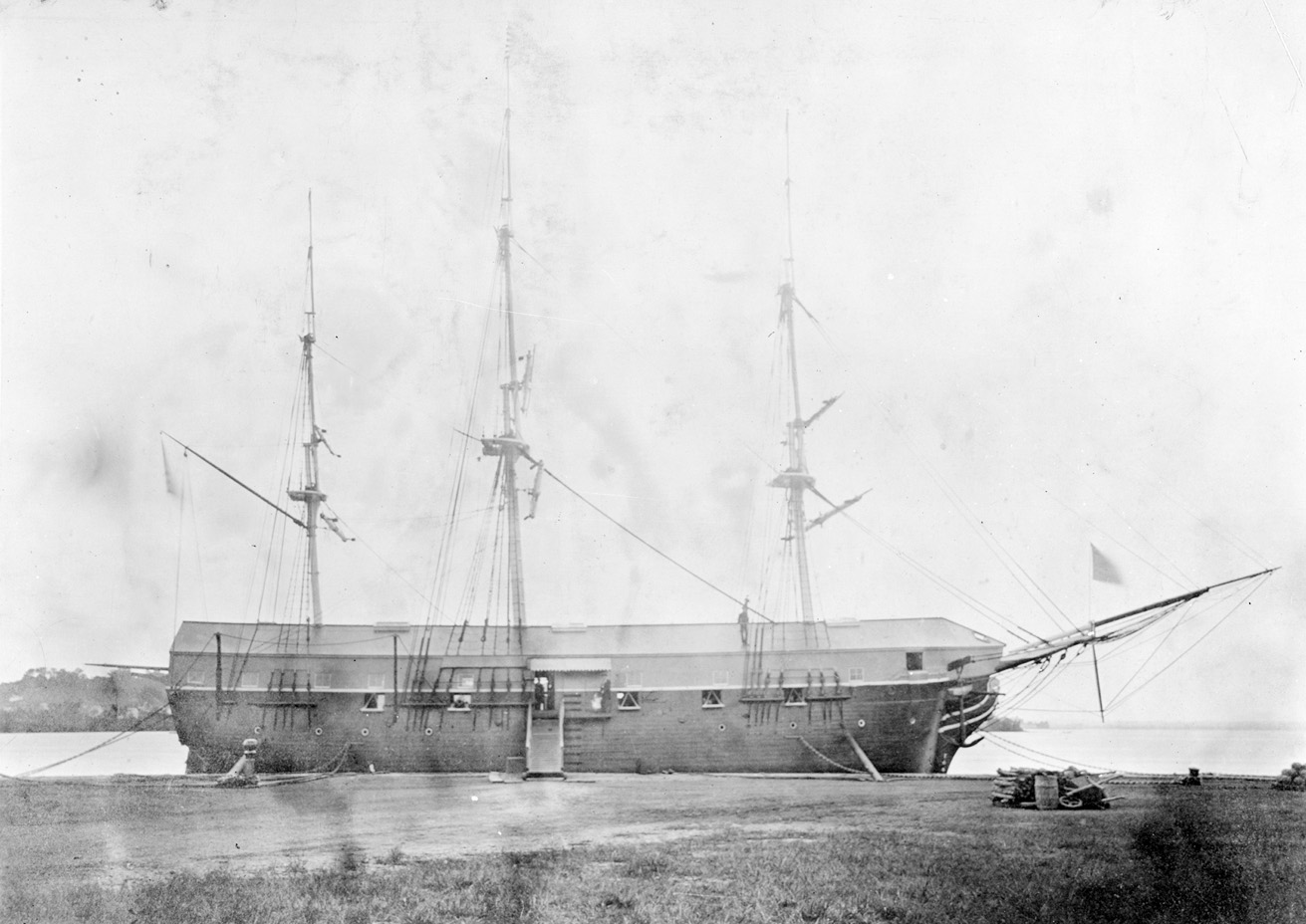
USS Relief (1836-1883) Special Service (Europe), 1871. 4th Rate, 2 guns, 468 tons in 1872. With Worcester and Supply this purpose-built naval store ship was engaged during 1871 in "conveying supplies to the suffering people of France" after the Franco-Prussian War. She is shown here serving as a receiving ship at the Washington Navy Yard between late 1871 and 1877. See her page on this site here. Photo No. NH 61710 Source: U.S. Naval History and Heritage Command |
 |
-- Cyane
|
USS Cyane (1837-1887) Pacific Station, 1869-1871. 3rd Rate, 2nd Class, 14 guns (nominal), 950 tons, in 1872. This ship was built in 1837 as a 22-gun sloop of war and is shown here in a watercolor by her gunner, William H. Myers, under sail while serving on the Pacific Station in 1842-1843. She was decommissioned on 4 March 1866 at Mare Island and converted to a store ship. She was recommissioned on 4 September 1867 with an armament of two 32-pdr smoothbores for service along the west coast of North America and was decommissioned in 1871. Photo No. NH 54486 Source: U.S. Naval History and Heritage Command |
 |
-- Supply
|
USS Supply (1843-1884) European Station and Special Service, 1869-1879. 4th Rate, 16 guns, 547 tons in 1872. This former merchant ship is shown after the Civil War at the New York Navy Yard with the receiving ship Vermont on the left and the smokestacks of a Wampanoag class steam cruiser behind Supply's mizzen mast. After postwar service on the European Station she was used in 1871-1879 for special missions such as carrying food relief to France and American exhibits to exhibitions in Europe. See her page on this site here. Photo No. NH 108862 ex NR&L(O) 21480 Source: U.S. Naval History and Heritage Command |
 |
-- Purveyor, ex J.C. Kuhn
|
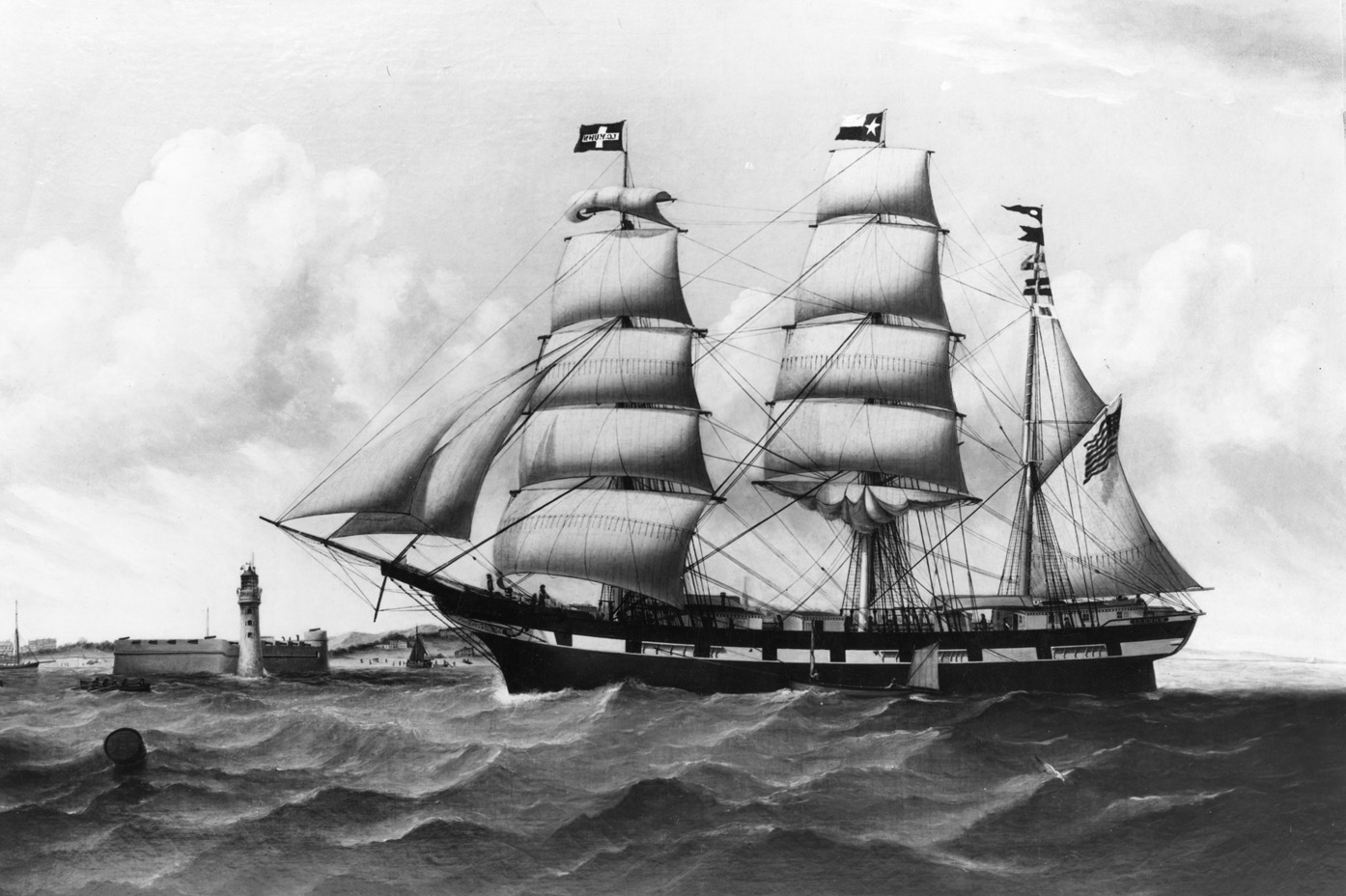
USS Purveyor (1861-1869) Special Service, 1868-1869. This painting of the merchant bark J.C. Kuhn in 1860 off Liverpool, England, is probably a copy of one by Duncan McFarlane. She is flying the house flag of J.H. Brower & Co. of New York. The ship was renamed Purveyor on 10 April 1866 and supplied the European and South Atlantic stations and then performed special service as a store ship before being decommissioned in mid-1869. See her page on this site here. Photo No. NH 52198 Source: U.S. Naval History and Heritage Command |
 |
-- Guard
|
USS Guard (1861-1883) European Station and Special Service, 1869-1878. 4th Rate, 4 guns, 925 tons in 1872. This former merchant ship served as a store ship on the European Station in 1866-69, supported an expedition in 1870 that surveyed the Isthmus of Darien for a possible canal route, and supported U.S. participation in international exhibitions in 1873-74 and astronomical surveys in 1877-78. See her page on this site here. |
|
-- Onward
|
USS Onward (1861-1884) Pacific Station, 1869-1884. 4th Rate, 3 guns, 704 tons in 1872. After hunting for Confederate commerce raiders during the Civil War, this former clipper ship served as a store ship, successively for the South Atlantic Station in 1866-67, for the Asiatic Station in 1867-68, and at Callao for the South Pacific Squadron in 1869-1884. See her page on this site here. |
|
Former Steam Cruisers
|
USS Idaho (1864-1874) Asiatic Station, 1869-1873. 3rd Rate, 1st Class, 7 guns, 3310 tons, in 1872. Watercolor on silk from the collection of President Franklin D. Roosevelt depicting Idaho under full sail following her conversion to a storeship. As such she proved to be extremely fast, once logging 18.5 knots. She was built as a fast steam cruiser of the Wampanoag group, but her engines, designed by a lawyer with political connections, were a total failure and were removed. Idaho was then commissioned on 3 October 1867 as a sailing store and hospital ship for the Asiatic Station. On 20 September 1869 she sailed from Yokohama for San Francisco but was mauled by a typhoon the next day and returned to Yokohama, where she was reduced to a housed-over hulk until being decommissioned on 31 December 1873. Photo No. NH 1422 Source: U.S. Naval History and Heritage Command |
 |
-- Pawnee
|
USS Pawnee (1859-1884) North Atlantic Station, 1870-1882. 3rd Rate, 2nd Class, 2 howitzers (12 guns notional), 1650 tons, in 1872. Following service as a steamer on the South Atlantic Station this shallow-draft steam sloop had her engines removed at Portsmouth in 1869 and was then converted at Norfolk to a hospital and store ship. After recommissioning on 17 December 1870 she sailed for Key West on 7 January 1871 where she served as hospital ship and receiving ship for the North Atlantic Station. In April 1875 she was towed to Port Royal for use as a store ship there. She was decommissioned on 18 November 1882 and sold on 3 May 1884. Illustrated here as a large 3rd Rate steamer. |
|
-- Monongahela
|
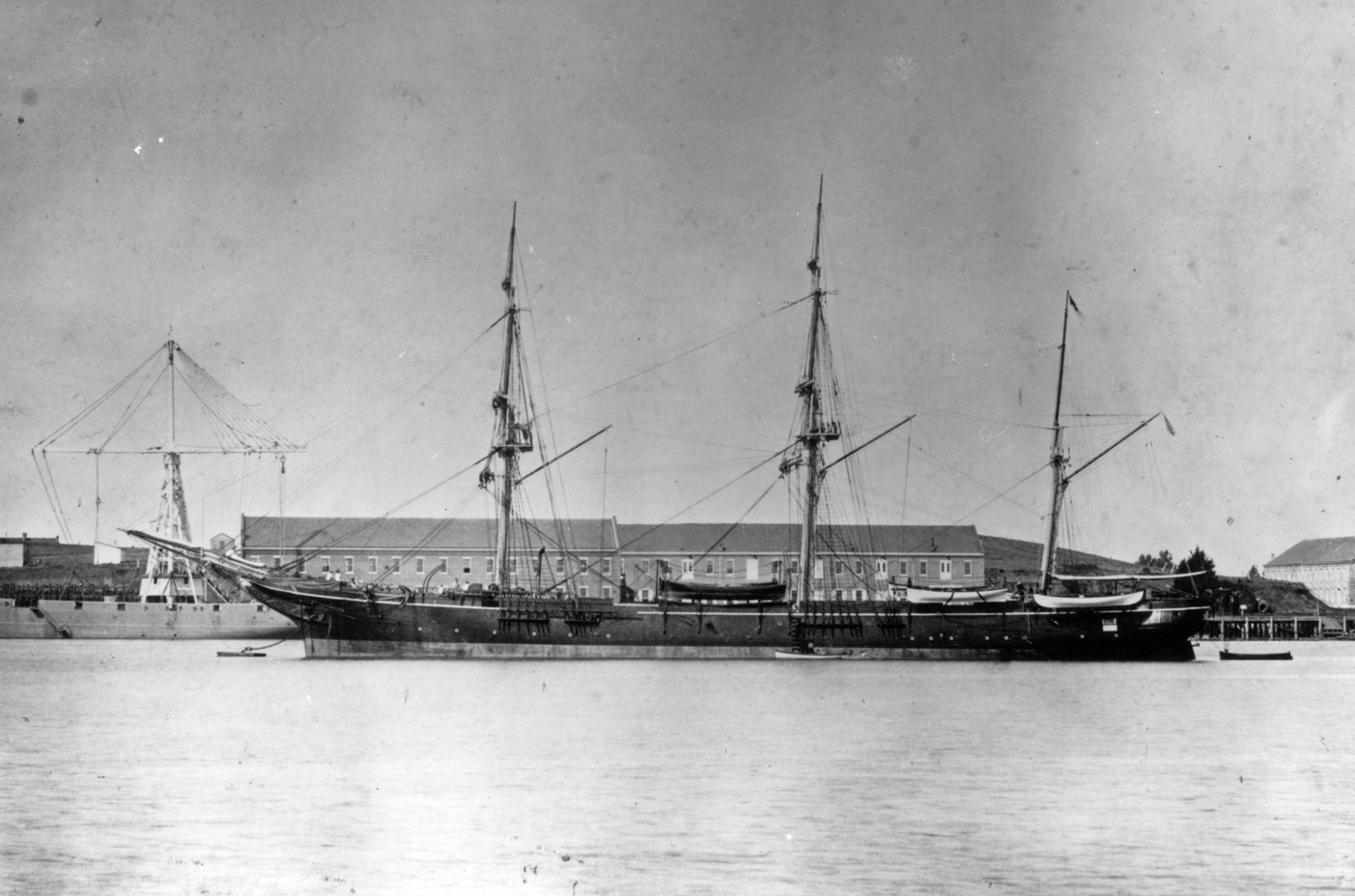
USS Monongahela (1862-1908) Pacific Station, 1884-1890. 3rd Rate, 1st Class, 2 guns, 2100 tons, in 1885. Photographed at Mare Island in July 1884 after being converted to a sailing store ship. All of her machinery was removed in the fall of 1883 to make additional room for supplies. During the conversion her rig was changed to a bark to allow handling by a smaller crew. In 1890 she was fitted at the Portsmouth N.H. Navy Yard as an apprentice sail training ship with a ship rig. The new steam sloop Mohican (2) is fitting out at the left. Illustrated here as a small 2nd Rate steamer. Photo No. NH 45209 Source: U.S. Naval History and Heritage Command |
 |